FeNO in COPD: A Useful Test, but Not the One You Might Expect
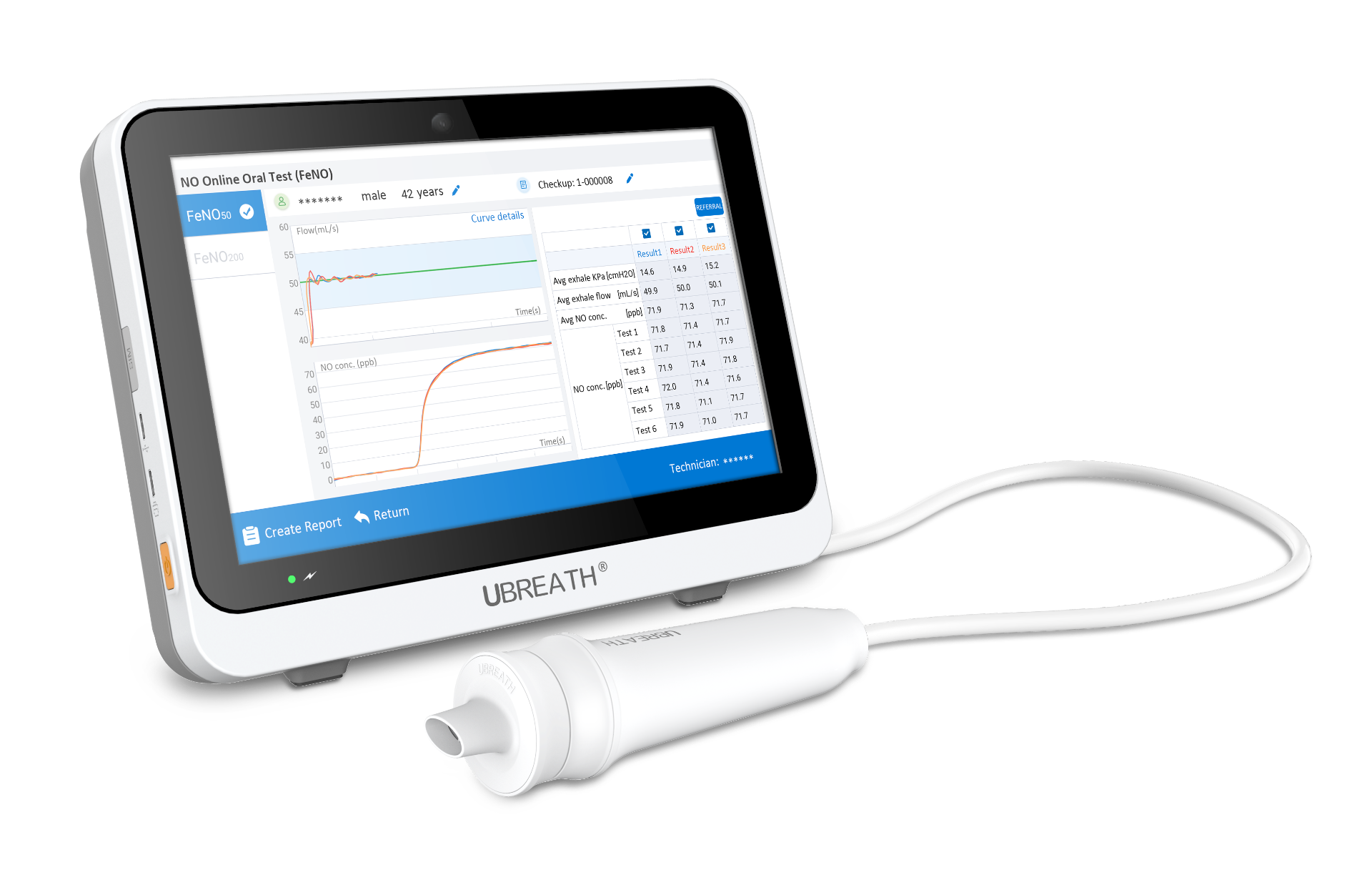
Fractional exhaled nitric oxide, or FeNO, has a well-earned reputation in asthma. A patient breathes slowly into a handheld device, and within seconds a number appears in parts per billion—a non-invasive readout of type 2 airway inflammation. It is quick, reproducible, and standardized by two decades of methodological work from the American Thoracic Society and the European Respiratory Society. It is natural to assume that a test this convenient should also help diagnose chronic obstructive pulmonary disease. The reality is more nuanced: FeNO is useful in COPD, but largely for a different question than “does this patient have COPD?”

What FeNO actually measures. FeNO is generated almost entirely by the airway epithelium through inducible nitric oxide synthase (iNOS), an enzyme whose transcription is driven primarily by interleukin-13 (IL-13), with IL-4 in a supporting role. In plain terms, FeNO reports on the activity of an IL-13-driven epithelial inflammatory pathway. This matters because the IL-5/eosinophil pathway runs in parallel and is not directly captured by FeNO—which explains why FeNO correlates only moderately with sputum eosinophils, and why it is sensitive to factors such as inhaled corticosteroids, smoking, atopy, and infection. FeNO is not a generic “inflammation meter.” It is a readout of a specific biological circuit.
Where FeNO earns its place: separating COPD from asthma–COPD overlap. Classic COPD has traditionally been framed as a Th1-driven, neutrophil-predominant process, but a meaningful subset of patients carries a type 2, eosinophilic component. This is the ground on which FeNO becomes clinically relevant in COPD. A 2026 systematic review found that FeNO shows moderate diagnostic accuracy for differentiating COPD from asthma–COPD overlap (ACO), with an area under the curve of 0.76 to 0.78, and that incorporating FeNO allowed diagnostic reclassification in up to 25% of cases while improving prediction of response to inhaled corticosteroids. In a study of patients not using inhaled corticosteroids, an FeNO cutoff of 25.0 ppb yielded 60.6% sensitivity and 87.7% specificity for distinguishing ACO from COPD, and combining FeNO ≥25.0 ppb with a blood eosinophil count ≥250/μL raised specificity to 96.1%. Other analyses have proposed cutoffs of 31.5 ppb in patients with a smoking history and 39.5 ppb in broader cohorts, with higher specificity than sensitivity. The pattern across studies is consistent: FeNO is better at ruling in an asthma-like, corticosteroid-responsive component than at ruling it out.
What FeNO does not do well in COPD. FeNO is generally low in people with COPD, particularly in current smokers. Cigarette smoke appears to suppress exhaled nitric oxide, possibly through feedback inhibition from the high NO concentrations in smoke, downregulation of NO synthase, or inadequate supply of necessary cofactors. Inhaled corticosteroids also lower FeNO. The practical consequence is that a “normal” FeNO in a current smoker with COPD carries far less reassurance than the same value in a non-smoker, and the test performs best when measured before corticosteroid treatment is started. One analysis found that FeNO retained diagnostic value for ACO only after excluding the influence of both inhaled corticosteroid use and smoking history, and even then the optimal cutoff shifted. There is also no universally accepted fixed cutoff for “elevated FeNO” in COPD, and the evidence base remains methodologically heterogeneous.

A further caution comes from the world of biologic therapy. In the BOREAS trial of dupilumab in COPD, treatment effects increased with higher baseline FeNO, which is conceptually logical given that FeNO reflects IL-4/IL-13-mediated inflammation. But a commentary in The Lancet Respiratory Medicine questioned whether FeNO adds incremental predictive value beyond blood eosinophil count in COPD, arguing that until prospective trials demonstrate independent utility, there is little reason to propagate its measurement for that purpose. The GOLD 2025 report treats FeNO as a potential biomarker for assessing type 2 inflammation in COPD rather than a routine diagnostic standard, and couples it with other biomarkers such as blood eosinophils.
The realistic clinical role. FeNO should not be positioned as a stand-alone diagnostic test for COPD. Its value lies in phenotype refinement: flagging a patient with COPD whose disease has an asthma-like, eosinophilic, corticosteroid-responsive component; supporting the identification of ACO when spirometry is ambiguous; and informing inhaled corticosteroid decisions alongside blood eosinophils. In primary care, where access to specialist assessment and spirometry can be limited, FeNO is being tested as part of a broader diagnostic package rather than a replacement for lung function testing. Pilot programs in the UK have distributed FeNO machines to general practices specifically to support earlier and more accurate diagnosis of asthma and COPD, paired with training on interpretation.
The takeaway is not that FeNO is unhelpful in COPD. It is that the test answers a narrower and more specific question than its reputation in asthma might suggest. In a disease as heterogeneous as COPD, a cheap, non-invasive marker that can identify a treatable inflammatory trait is genuinely valuable—provided it is read for what it measures, and not for what it does not.