Impulse Oscillometry (IOS): Listening to the Lungs When Spirometry Cannot
For decades, spirometry has been the cornerstone of lung function testing. A patient takes a deep breath and blasts it out as hard and fast as possible, and the numbers that emerge—FEV1, FVC, and their ratio—tell clinicians whether airflow is blocked. But spirometry has a quiet, persistent limitation: it demands a forced maneuver that many people simply cannot perform reliably. Young children, frail elderly patients, individuals with cognitive or neurological impairments, and those with severe advanced disease often produce effort-dependent results that are difficult to trust.
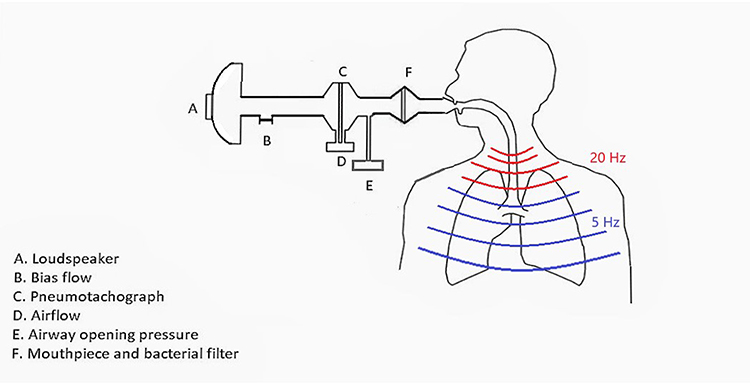
Impulse oscillometry, or IOS, sidesteps that problem entirely. Instead of asking the patient to force air out, IOS sends tiny sound waves—pressure oscillations at multiple frequencies—into the airways during quiet, normal tidal breathing. The device measures how the respiratory system resists and reacts to those waves, producing a mechanical portrait of the lungs without requiring any forced effort at all. In an era when lung function testing needs to reach populations that spirometry struggles to serve, IOS is earning attention not as a replacement, but as a complementary tool with distinct physiological insight.
Reading the Lungs in Resistance and Reactance
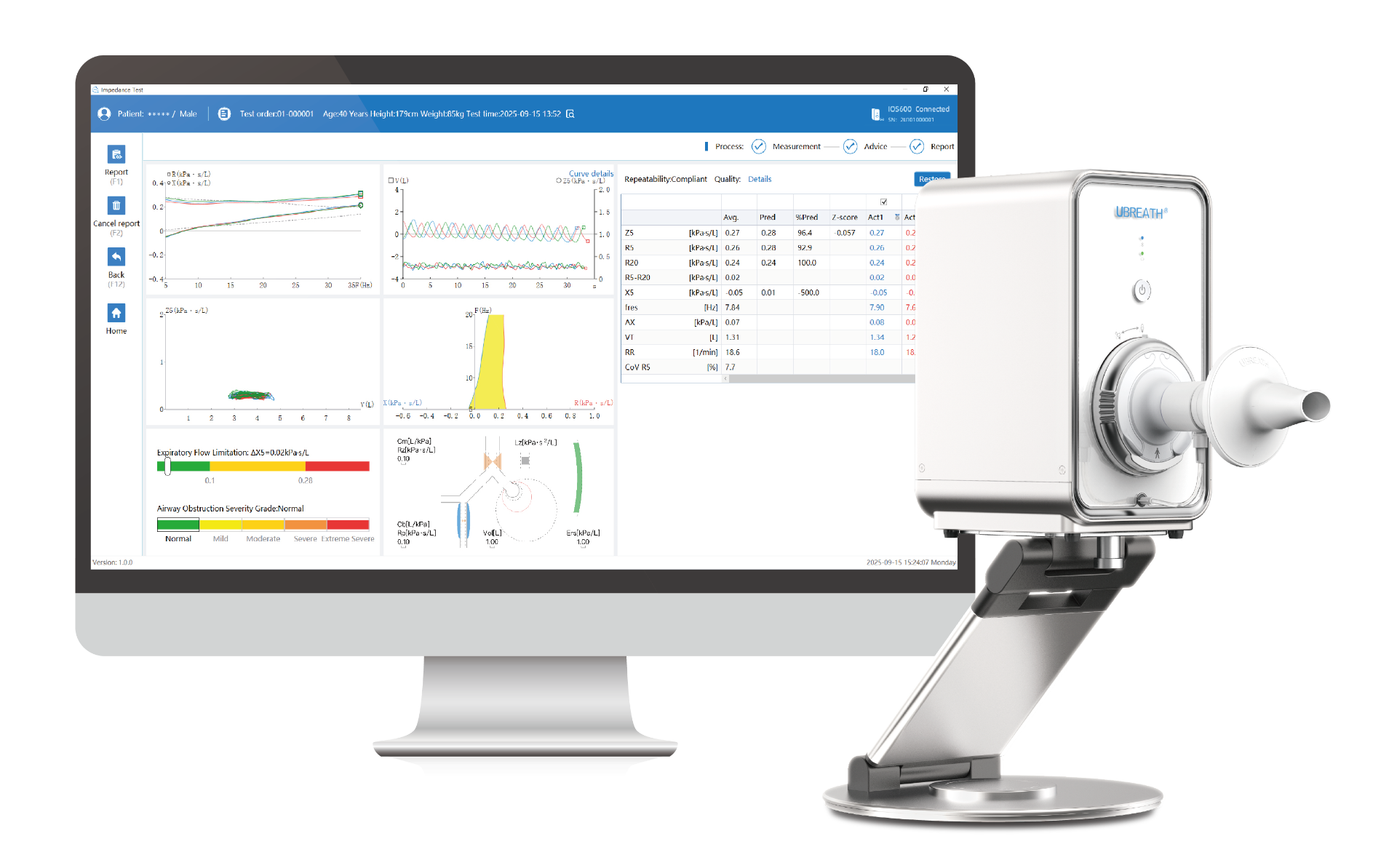
IOS reports two families of parameters: resistance (R) and reactance (X). Resistance reflects how much the airways oppose airflow. Resistance at 5 Hz (R5) captures the total resistance of the entire bronchial tree, from mouth to alveoli, while resistance at 20 Hz (R20) reflects mainly the larger, central airways. The difference between the two, R5–R20, isolates the contribution of the small airways—the quiet, peripheral branches less than 2 mm in diameter that conventional spirometry often misses.
Reactance describes the elastic and inertial properties of the lung periphery. X5, reactance at 5 Hz, becomes more negative when the distal lung units lose compliance and trap air. The area of reactance (AX) integrates this burden across the breathing cycle, and the resonant frequency (Fres) marks the point where elastic and inertial forces cancel each other out—rising as peripheral obstruction and stiffness worsen. These parameters matter because small airway dysfunction can be present and clinically relevant long before spirometry detects an abnormality. A patient with a normal FEV1/FVC ratio may still have elevated R5–R20, a more negative X5, and an increased AX, signaling that the quiet zone of the lung is already under strain.
Where IOS Changes Clinical Conversations
The clearest strength of IOS lies in populations and scenarios where spirometry is impractical or insufficient. In preschool children with recurrent wheeze, IOS is feasible during tidal breathing and has been shown to predict active asthma and impaired lung function at school age. Combining IOS with fractional exhaled nitric oxide (FeNO) improves the ability to identify preschool children at risk of asthma, offering an objective anchor in an age group where diagnosis otherwise rests heavily on symptom patterns. In adults, IOS detects increased airway resistance with greater sensitivity than spirometry in the early stages of asthma and COPD, even when spirometry remains normal in asymptomatic smokers or patients with preserved lung function.
IOS also adds nuance to disease monitoring. In COPD, IOS-defined bronchodilator responsiveness has been linked to worse symptom burden and a different clinical trajectory, and IOS parameters such as R5–R20 and AX have been associated with exacerbation risk and loss of asthma control. In bronchiectasis, IOS indices correlate with disease severity scores and predict outcomes including exacerbations and hospital admissions, suggesting a role beyond diagnosis in longitudinal management. And because IOS is effort-independent, it opens a practical door in primary care settings where spirometry access or expertise is limited—oscillometry has been described as a valid alternative for patients too young, too frail, or otherwise unable to reproducibly perform forced expiratory maneuvers.
What IOS Is Not
The enthusiasm around IOS should be calibrated by its limitations. It is not a stand-alone diagnostic test, and its parameters should be interpreted alongside symptoms, exacerbation history, bronchodilator response, and—when available—spirometry. Reference values and prediction equations remain less standardized than those for spirometry, and technical factors such as mouth seal and glottal closure can introduce error if not carefully controlled. European Respiratory Society technical standards emphasize attention to testing protocols, quality control, and the order of testing—oscillometry should be performed before maneuvers that require a deep breath, since a deep inhalation can transiently alter airway mechanics. IOS also does not directly measure lung volumes or gas exchange; it describes mechanical impedance, not ventilation or diffusion.
A Complementary Listening Post
The clinical value of IOS is perhaps best understood not as a contest with spirometry but as a different kind of listening. Spirometry asks the lungs to shout. IOS listens to them speak at rest. For the patient who cannot shout—the four-year-old with wheeze, the octogenarian with severe COPD, the neurologically impaired adult—that quiet signal may be the only objective evidence available. For the patient who can perform spirometry but whose small airways are already whispering distress, IOS may hear what the forced maneuver misses. As evidence accumulates and standardization matures, IOS is steadily finding its place as a complementary physiological tool: one that measures the mechanics of breathing in the populations and moments where conventional testing falls silent.