Reading a FeNO Report the Right Way: What the Chinese Expert Consensus Means for Standardized Interpretation — and How UBREATH® Supports It
By e-linkcare | Clinical Respiratory Insights
Fractional exhaled nitric oxide (FeNO) testing is now widely recognized as a non-invasive biomarker of type 2 airway inflammation. It helps clinicians assess airway inflammation, predict corticosteroid responsiveness, support asthma diagnosis, and guide treatment adjustment. But as FeNO testing expands from specialized pulmonary function laboratories into routine respiratory practice, one question becomes increasingly important:
What exactly should a clinician read from a FeNO report?
The 2026 Chinese Expert Consensus on the Testing Process Quality Control and Clinical Application of Fractional Exhaled Nitric Oxide Detectors, developed by the Task Force for Pulmonary Function of the Chinese Thoracic Society, provides a practical answer. The consensus, formatted as 14 question-and-answer recommendations, emphasizes that a reliable FeNO result is not merely a single number. It is the product of pre-test quality control, standardized sampling, real-time curve verification, appropriate parameter selection, age-specific interpretation, and longitudinal comparison.
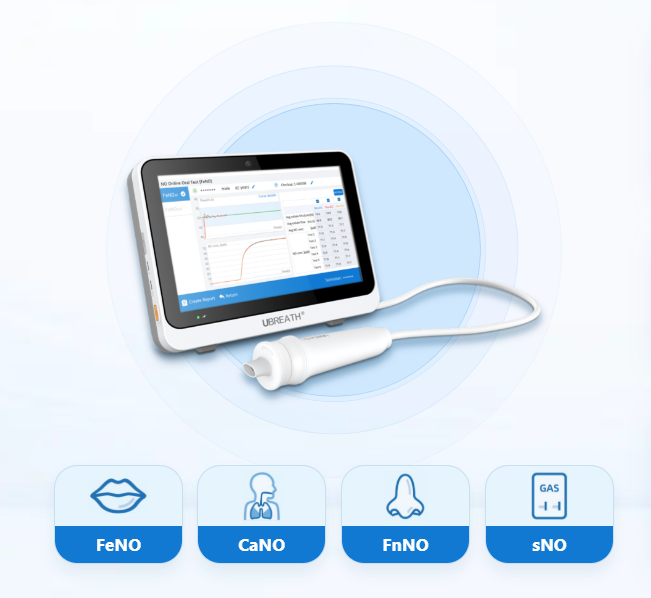
This article explains how to read a FeNO report in a structured way — and how the UBREATH® Exhaled Breath Analyzer (BA200 / BA800) from e-linkcare is designed to support this standardized interpretation workflow.
1. A FeNO Report Should Answer Five Clinical Questions
According to the consensus, a FeNO test report should contain at least three parts:
-
Basic information — subject demographics, relevant medical history, test time, and pre-test conditions;
-
Test information — measured parameters, measured values, flow–time curves, concentration–time curves, and historical trend charts;
-
Clinical reference information — normal values, abnormal ranges, and corresponding clinical significance.
In practical terms, a well-designed report should allow the clinician to answer five questions quickly:
-
Who was tested?
-
Was the test performed reliably?
-
Which airway compartment was measured?
-
What does the value mean in this patient?
-
Has the value changed compared with previous assessments?
A FeNO report that provides only “FeNO = 38 ppb” without context is clinically incomplete. The consensus clearly moves FeNO reporting from a single-value output toward a quality-controlled, interpretable, and traceable clinical record.
2. Basic Information: The First Filter for Clinical Interpretation
The consensus lists multiple factors that may affect FeNO measurements, including age, sex, diet, smoking, medications, infection, exercise, and pulmonary function testing. Therefore, the basic information section is not administrative paperwork — it is the first filter for judging whether the result can be interpreted confidently.
A standardized report should document:
-
Subject characteristics — name, sex, age, height, and weight, which are needed for age-related cutoff selection;
-
Test environment — ambient temperature, humidity, and barometric pressure, because NO sensors require stable environmental conditions;
-
Pre-test status — whether the patient avoided NO-affecting foods, whether they smoked or abstained from smoking, and whether they used inhaled or oral corticosteroids, biologics, nasal medications, or other drugs that may alter FeNO or FnNO;
-
Symptoms — cough, wheeze, nasal obstruction, sneezing, and other relevant clinical features;
-
Test sequence — FeNO testing should preferably be completed before routine pulmonary function testing, because forced expiratory maneuvers may temporarily reduce FeNO.
Interpretation point: A FeNO value should always be read together with its pre-test context. If the report does not record recent food intake, smoking status, medication use, or test sequence, the clinical meaning of the number is weakened.
The UBREATH® report template structures this information so that the measured value is always presented with its clinical background.
3. Test Information: Look at How the Result Was Obtained, Not Only the Result Itself
The consensus requires test information to include measurement parameters, measured values, flow–time curves, and concentration–time curves. For clinicians, this section is essential for judging whether the measurement was performed within acceptable quality-control limits.
3.1 First, identify the measured parameters
A multi-parameter FeNO report may include:
-
FeNO₅₀ (50 mL/s) — the default oral exhaled NO parameter, primarily reflecting large-airway inflammation and widely used in asthma and corticosteroid-responsive cough assessment;
-
FeNO₂₀₀ (200 mL/s) — a higher-flow measurement that better reflects small-airway and alveolar NO levels and, when combined with CaNO, helps distinguish central from peripheral airway inflammation;
-
CaNO — alveolar NO concentration calculated from the two-compartment model; it serves as an adjunct marker of small-airway/alveolar inflammation, although the consensus notes that standardized cutoffs remain undefined;
-
FnNO — nasal exhaled NO, reflecting upper-airway inflammation, especially in the nasal cavity and sinuses; in adults, the exhalation-against-resistance method is recommended, with FnNO₁₀ (10 mL/s) commonly used;
-
Derived parameters such as JawNO and DawNO — useful for understanding NO production, diffusion, and clearance, mainly as research or advanced clinical adjuncts.
Interpretation point: Do not use FeNO₅₀ alone to answer every airway question. The large airways, small airways, and upper airways are different anatomical regions. The value of a multi-parameter report lies in compartment-specific interpretation, not in simply listing more numbers.
3.2 Flow–time curve: Was the maneuver technically acceptable?
The consensus specifies that FeNO₅₀ should be maintained at 45–55 mL/s, while FeNO₂₀₀ should be maintained at 200 ± 20 mL/s. Exhalation flow above the target range tends to lower FeNO values, while flow below the range tends to raise them.
When reviewing the flow–time curve, focus on three features:
-
Stable plateau — whether the curve remains steady near the target flow rate rather than fluctuating;
-
Leak or inadequate inhalation — abnormal fluctuations, early termination, or a missing plateau may suggest incomplete lip seal, insufficient inhaled volume, or a problem with the gas path connection;
-
Adequate exhalation time — adults generally need slow, steady exhalation for about 10 seconds, with age-appropriate adjustments for children; the plateau must be long enough to allow a stable measurement window.
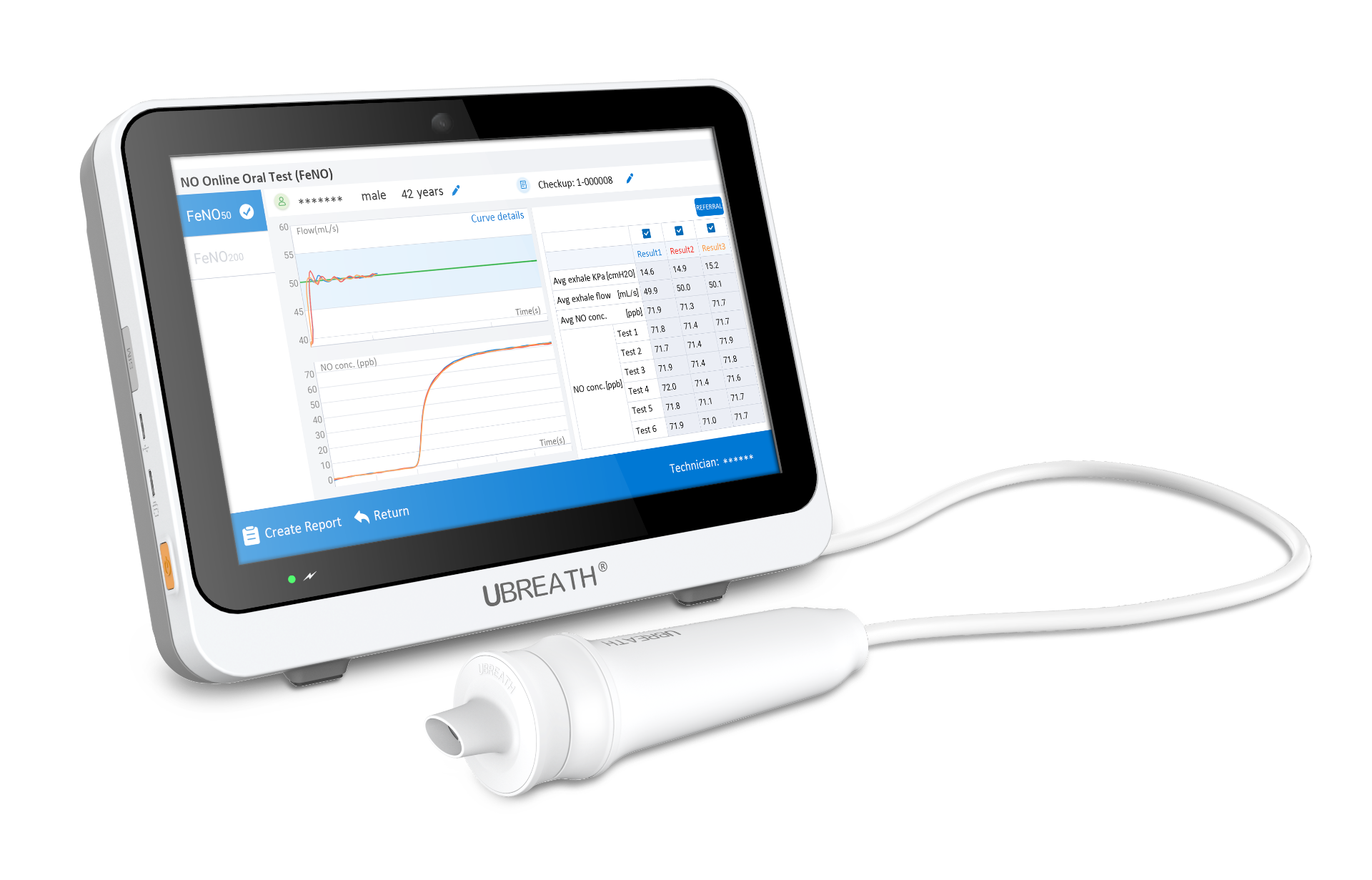
Interpretation point: The flow–time curve is not decorative. It is the first piece of evidence for deciding whether a measurement should be accepted. UBREATH® displays the flow waveform in real time, allowing the operator to identify instability immediately and repeat the test when necessary — moving quality control from retrospective review to the point of measurement.
3.3 Concentration–time curve: Did the NO signal reach a stable plateau?
The consensus notes that exhaled NO has an early peak and washout phase during the first 6–7 seconds of exhalation, followed by a relatively stable plateau. The reported value should be based on the mean value within a 3-second window of the plateau phase.
The concentration–time curve should be reviewed for:
-
A stable plateau — ideally lasting at least 3 seconds, with less than 10% variation over the measurement range;
-
Premature loss or continuous rise of the plateau — possibly indicating unstable flow, air leakage, nasal NO contamination, or sampling problems;
-
Abnormal peak shape — helpful for identifying technical errors or interference.
Interpretation point: A “good-looking number” must be built on a “good-looking plateau.” A FeNO value without a stable concentration plateau should not be used as a reliable basis for clinical decisions. UBREATH® presents the concentration–time curve alongside the result, turning the report from a result sheet into a process record.
3.4 Repeatability: The report should show whether the result can be reproduced
The consensus recommends that subjects perform at least two reproducible measurements with ≤10% variation, with approximately 30 seconds of rest between maneuvers. If the difference exceeds 10%, an additional exhalation should be performed.
Interpretation point: Single measurements may be difficult to avoid in busy clinics, but the report should at least indicate whether the result is a single value or a mean of repeated measurements. UBREATH® supports recording repeated measurements and displaying the mean, facilitating quality-control review.
4. Clinical Reference Information: Interpret Cutoffs in the Right Age and Clinical Context
The consensus emphasizes that FeNO reports should include normal values, abnormal ranges, and corresponding clinical significance. Interpretation must not be separated from age and clinical context.
4.1 Adults (>12 years)
Common interpretation thresholds include:
-
<25 ppb — non-type 2 inflammation is more likely;
-
25–50 ppb — suspicious type 2 airway inflammation; interpret together with symptoms, lung function, and allergy history;
-
>50 ppb — suggests type 2 airway inflammation; in patients with compatible clinical evidence, this supports a diagnosis of asthma;
-
In patients with chronic or subacute cough, FeNO >25 ppb combined with clinical features of corticosteroid-responsive cough (CRC) supports the diagnosis of CRC.
4.2 Children (≤12 years)
-
<20 ppb — non-type 2 inflammation is more likely;
-
20–35 ppb — suspicious type 2 inflammation;
-
>35 ppb — suggests type 2 inflammation.
4.3 FnNO interpretation
-
Normal FnNO in healthy individuals is generally 250–500 ppb;
-
Allergic rhinitis may show elevated FnNO correlating with inflammation severity, whereas non-allergic rhinitis usually shows normal levels;
-
Chronic sinusitis may reduce FnNO;
-
FnNO <77 ppb supports a diagnosis of primary ciliary dyskinesia (PCD); in children aged 5–17 years, after excluding cystic fibrosis, FnNO <127 ppb shows high sensitivity and specificity for PCD.
4.4 CaNO interpretation boundaries
CaNO can serve as an adjunct marker of small-airway/alveolar inflammation and is best interpreted together with FeNO₂₀₀. However, the consensus explicitly states that standardized cutoffs for CaNO remain undefined. CaNO should not be used alone for diagnosis; it should be integrated with clinical findings, lung function, and other NO parameters.
Interpretation point: The “clinical reference” section of a report is not an automatic diagnostic conclusion. It is an interpretive framework that places the value back into the patient’s age, symptoms, and test indication. UBREATH® reports present measured parameters, measured values, reference ranges, and clinical significance side by side, helping clinicians complete the final step from number to interpretation.
5. Historical Trend Charts: The Most Underappreciated Part of a FeNO Report
The consensus report template includes a historical trend chart of NO measurement values. This section is particularly important for chronic airway disease management:
-
Baseline — what is the patient’s stable-phase FeNO level?
-
Direction of change — a decrease after treatment may suggest corticosteroid response; repeated increases may suggest inadequate inflammation control or adherence issues;
-
Magnitude of change — interpret changes against the ≤10% repeatability threshold;
-
Multi-parameter trends — if FeNO₅₀ decreases but FnNO or CaNO does not change in parallel, the inflamed compartment may differ.
Interpretation point: A single FeNO measurement is a cross-section; a trend chart tells the longitudinal story. UBREATH® reports support historical trend comparison, allowing clinicians to judge not only “is it high today?” but also “has it improved since last time, and is treatment working?”
6. A Four-Step Approach to Reading a UBREATH® FeNO Report
For rapid clinical adoption, a FeNO report can be read in four steps:
Step 1: Review basic information to assess interference.
Are diet, smoking, medication, symptoms, and environment documented? Was FeNO performed before pulmonary function testing?
Step 2: Review the two curves to assess quality control.
Was flow stable within the target range? Did the concentration curve form a stable plateau of at least 3 seconds? Were there signs of leakage, inadequate inhalation, or flow fluctuation?
Step 3: Review the parameter combination to assess compartment-specific inflammation.
FeNO₅₀ reflects large-airway inflammation; FeNO₂₀₀ and CaNO reflect small-airway/alveolar regions; FnNO reflects the upper airway. Do not use a single parameter to explain all airway compartments.
Step 4: Review cutoffs and trends to assess clinical significance.
Select age-appropriate cutoffs, integrate symptoms, lung function, medication, and historical trends, and form an interpretation rather than simply reporting a number.
7. How UBREATH® Supports the Consensus Workflow
The Chinese expert consensus is, in essence, pushing FeNO testing from a single-point value toward quality-controlled, interpretable, and traceable clinical evidence.
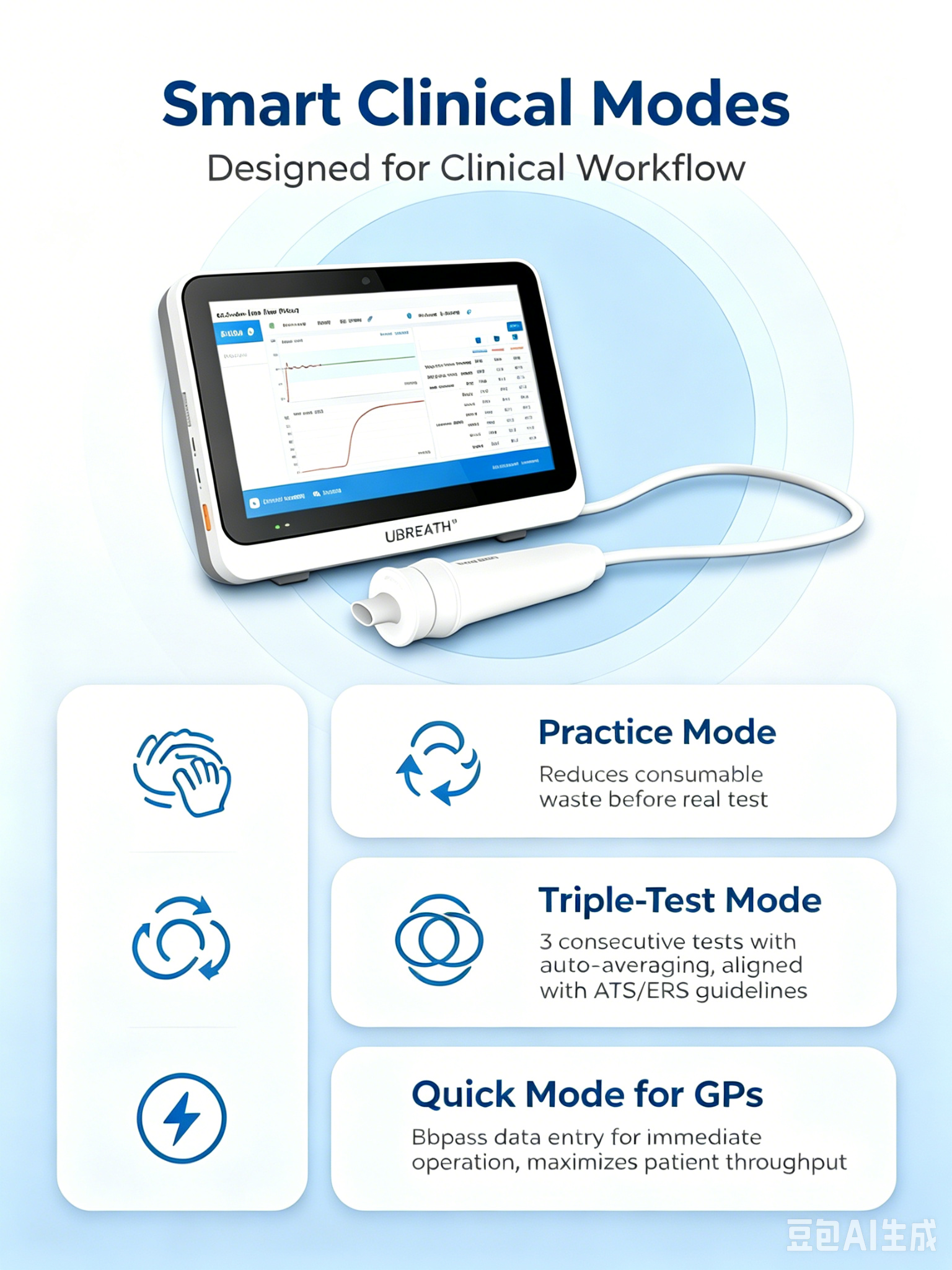
The UBREATH® Exhaled Breath Analyzer (BA200 / BA800) is designed to support this workflow with:
-
Multi-parameter output within one minute — FeNO, CaNO, and FnNO, with FeCO available on the BA200, supporting compartment-specific airway assessment;
-
0.1 ppb high-sensitivity biosensor — supporting resolution at low NO concentrations;
-
ATS/ERS-compliant standardization — aligning with internationally recognized measurement requirements;
-
Patented dual-channel design — helping reduce cross-contamination risk at the sampling interface;
-
Real-time flow–time and concentration–time curves — enabling quality control during the test rather than after it;
-
Structured report templates with historical trends — supporting standardized interpretation and longitudinal follow-up.
A good FeNO report should not make clinicians guess whether the number is reliable. It should show, clearly and directly, whether the test was performed stably, whether the parameters cover the relevant airway compartments, and whether the clinical interpretation has a defensible basis.
Conclusion
The Chinese Expert Consensus on FeNO testing process quality control and clinical application reinforces a simple but important principle: the clinical value of FeNO depends not only on the analyzer’s sensitivity, but also on the quality of the testing process and the standardization of report interpretation.
From pre-test preparation to flow and concentration curve verification, from compartment-specific parameters to age-specific cutoffs, and from single measurements to longitudinal trends, every element of the report contributes to the final clinical decision.
At e-linkcare, the UBREATH® platform is built to make that chain visible, verifiable, and clinically usable — so that precise respiratory diagnosis does not remain an abstract standard, but becomes a practical part of everyday airway disease management.
To learn more about the UBREATH® Exhaled Breath Analyzer (BA200 / BA800) and standardized FeNO reporting, please visit e-linkcare at https://www.e-linkcare.com/.