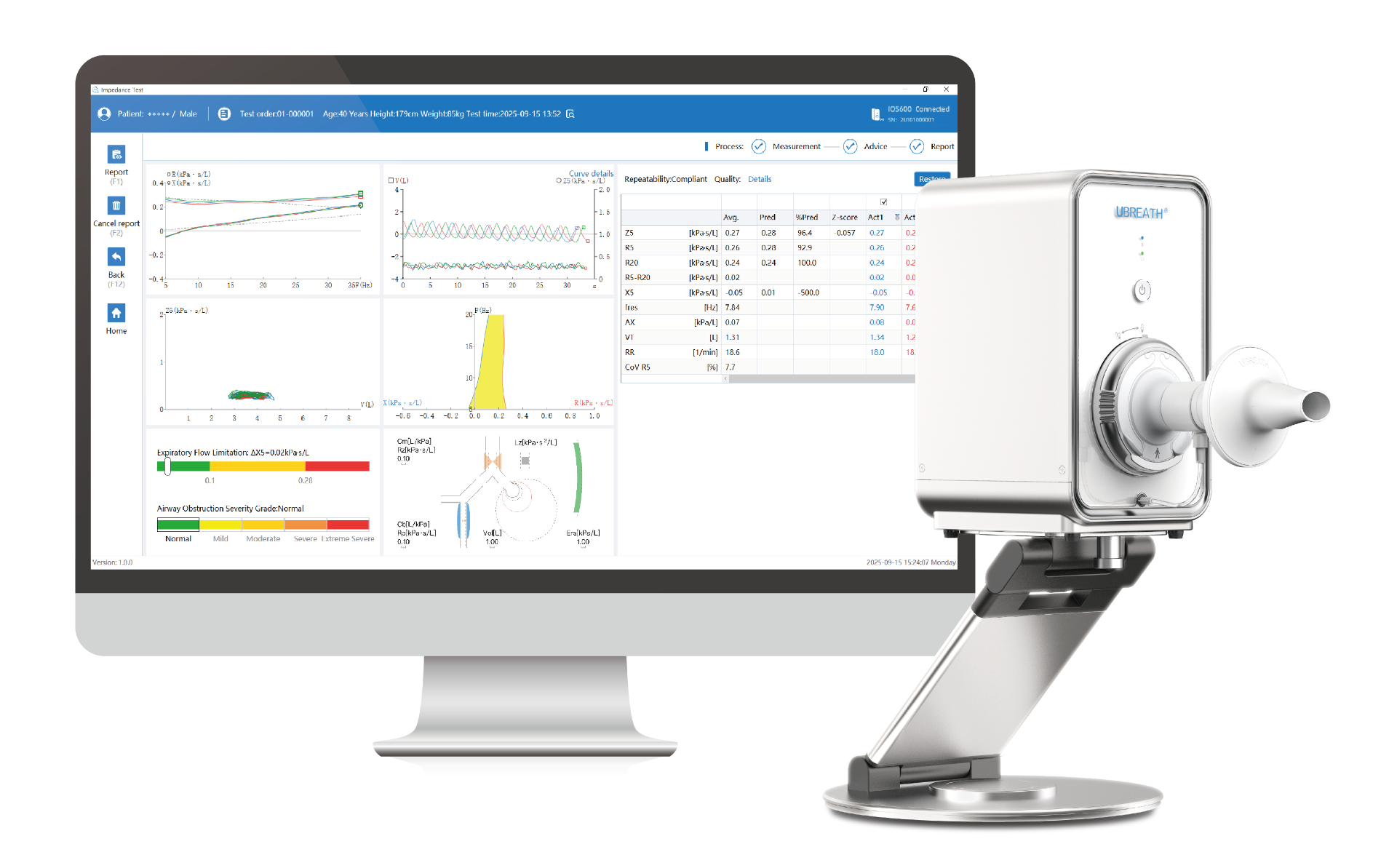
Impulse Oscillometry (IOS) vs. Forced Oscillation Technique (FOT): A Comparative Overview
What Are Oscillometry Techniques?
Both impulse oscillometry (IOS) and the forced oscillation technique (FOT) belong to a family of lung function tests known as oscillometry. Rather than requiring patients to perform forced breathing maneuvers — as spirometry does — oscillometry superimposes small pressure oscillations on normal tidal breathing and analyzes the resulting pressure–flow relationship to derive respiratory impedance (Zrs). This impedance has two key components: resistance (R), which reflects airflow limitation, and reactance (X), which is influenced by airway compliance and inertance.
The forced oscillation technique was first described by Dubois in 1956 and has since evolved through several iterations. IOS is a later modification of FOT, introduced by Michaelson in 1975, that uses a fundamentally different signal type to achieve the same physiological goals.

The Core Technical Difference
The most important distinction between IOS and conventional FOT lies in how the oscillatory signal is generated and delivered .
In classical FOT, a loudspeaker generates a pseudorandom noise signal — a continuous mixture of several sinusoidal waveforms at different frequencies. These frequencies are transmitted either sequentially or simultaneously, and the resulting pressure and flow signals are analyzed using Fourier transform to extract frequency-specific impedance values.
In IOS, by contrast, a loudspeaker delivers brief, regular square-wave pressure impulses at a constant frequency (typically 5 times per second). Each impulse, when decomposed via fast Fourier transform, contains a continuous spectrum of frequencies ranging from approximately 5 Hz to 35 Hz. This single-impulse approach means that a complete frequency spectrum can be captured from each pulse, generating a larger data sample in a shorter measurement time.
Why This Matters: Key Advantages of IOS
1. Superior Signal Quality and Data Density
Because each impulse in IOS contains multiple frequencies simultaneously, the system generates a larger sample of data per measurement compared to FOT's pseudorandom noise approach. This continuous frequency spectrum provides a more detailed characterization of respiratory function across the full range of relevant frequencies. Studies have confirmed that IOS can detect small airway dysfunction (SAD) even when conventional spirometry results are normal, with detection rates significantly higher than spirometry (46.55% vs. 15.52% in one comparative study).
2. Improved Signal-to-Noise Ratio
The impulse-based signal of IOS offers a better signal-to-noise ratio than sequentially transmitted FOT frequencies, because the brief high-amplitude pulse produces a stronger signal that is easier to distinguish from background physiological noise. This advantage is particularly important in clinical settings where patient breathing patterns, swallowing, or upper airway artifacts can degrade measurement quality.
3. Greater Sensitivity in Detecting Small Airway Dysfunction
One of the most significant clinical advantages of IOS is its exceptional sensitivity in detecting early small airway dysfunction — a condition that spirometry frequently misses because forced expiratory maneuvers themselves can induce volume-dependent closure of small airways. The IOS parameter R5–R20 (the difference between resistance at 5 Hz and 20 Hz) is a well-established marker of peripheral airway obstruction that can be elevated even in patients with normal spirometry results. Moreover, IOS shows similar or even higher sensitivity than spirometry in detecting small airways dysfunction, and IOS parameters appear to be superior to spirometry in predicting loss of control in asthmatic patients.
4. Effort-Independent and Patient-Friendly
Both IOS and FOT require only passive cooperation — the patient simply breathes normally through a mouthpiece while supporting their cheeks. No forced exhalation, breath-holding, or specific breathing maneuvers are needed. This makes both techniques suitable for young children, elderly patients, and those with severe respiratory impairment who cannot perform spirometry. However, IOS's shorter measurement time (typically 30–60 seconds for a complete assessment) further enhances its clinical practicality.
5. Differentiation Between Central and Peripheral Airways
The broad frequency spectrum generated by IOS allows for differentiation between large and small airway obstruction through frequency-dependent analysis. Resistance at low frequencies (e.g., 5 Hz) reflects total airway resistance, while resistance at higher frequencies (e.g., 20 Hz) primarily reflects central airway resistance. The difference (R5–R20) therefore isolates the peripheral airway component. This frequency-dependent profiling is more consistently achievable with IOS because of the continuous and wide frequency spectrum inherent in each impulse.

Understanding the Limitations
FOT's Known Constraints
Conventional FOT faces several limitations that IOS helps mitigate. FOT measures generally show greater variability than spirometry, and a lack of standardization across different devices and testing protocols has slowed its clinical adoption. The need to view respiratory mechanical parameters over a range of frequencies — a concept that requires understanding of the mathematics and engineering theory behind oscillometry — has also hindered widespread clinical acceptance. Furthermore, FOT may fail to identify lung function abnormalities in certain populations, such as children with restrictive physiology, where FOT findings correlate poorly with spirometry and plethysmography.
IOS Is Not Without Its Own Considerations
IOS is not without limitations. Some patients may find the brief pressure pulse of IOS slightly more noticeable — described as a “push” sensation — compared to the smoother continuous oscillations of FOT. Additionally, measurement values are not interchangeable between devices: IOS typically yields higher resistance values and reactance closer to zero compared to FOT, and the reactance area (AX) is smaller with IOS. These systematic differences mean that device-specific normative values and consistent quality control protocols are essential.
Clinical Applications and Outlook
IOS has been studied across a wide range of respiratory conditions, including COPD, asthma, interstitial lung diseases, and obstructive sleep apnea. Its greatest clinical advantage — particularly notable in pediatric populations — is the ability to monitor disease progression and assess treatment response in a simple, reproducible way with minimal patient cooperation. The technique is also suitable for measuring bronchodilator response and bronchoprovocation testing.
Interest in IOS is growing, and with accumulating evidence supporting its utility, it is expected to become more widely adopted and potentially on par with standard pulmonary function tests in the near future. For patients who cannot perform spirometry — including young children, elderly individuals, and those with severe disease — IOS offers a uniquely accessible and sensitive window into lung mechanics that complements traditional testing rather than replacing it.
Key Takeaway: While IOS and FOT share the same physiological foundation, IOS's impulse-based signal generation provides distinct technical advantages in signal quality, data density, and diagnostic sensitivity — particularly for detecting small airway dysfunction — making it an increasingly valuable tool in modern respiratory medicine.