Breathe Easy: How a Simple Breath Test Is Transforming Asthma Diagnosis
For millions of people worldwide who live with asthma, getting a correct diagnosis has long been a frustrating journey. Traditional lung function tests can be difficult to perform, especially for young children, and may miss cases where airway inflammation is present but breathing tests appear normal. A Canadian study of 613 patients with physician-diagnosed asthma found that a third did not actually have the condition when subjected to objective testing. Enter the fractional exhaled nitric oxide (FeNO) test — a simple, non-invasive breath test that is rapidly becoming a first-line tool in asthma diagnosis.
What Is FeNO and Why Does It Matter?
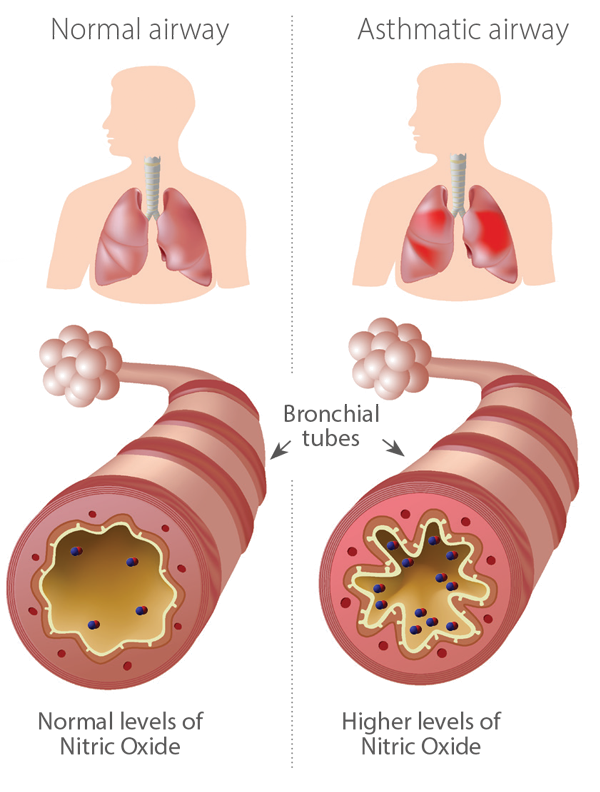
Nitric oxide (NO) is a gas naturally produced in the human body, and we exhale trace amounts of it with every breath. In people with eosinophilic airway inflammation — a hallmark of allergic (Type 2) asthma — the cells lining the airways produce excess nitric oxide, leading to elevated FeNO readings. Measuring this gas is like checking the "smoke detector" of the lungs: it tells doctors whether the airways are inflamed, even when other tests look normal.
The biology behind FeNO is now well understood. The gas is generated by the airway epithelium through inducible nitric oxide synthase, an enzyme whose production is driven primarily by interleukin-13, with interleukin-4 playing a supporting role. This direct mechanistic link to Type 2 inflammation makes FeNO a uniquely informative biomarker — it reflects the underlying inflammatory process in real time, rather than simply measuring its consequences on lung function.
How the Test Works
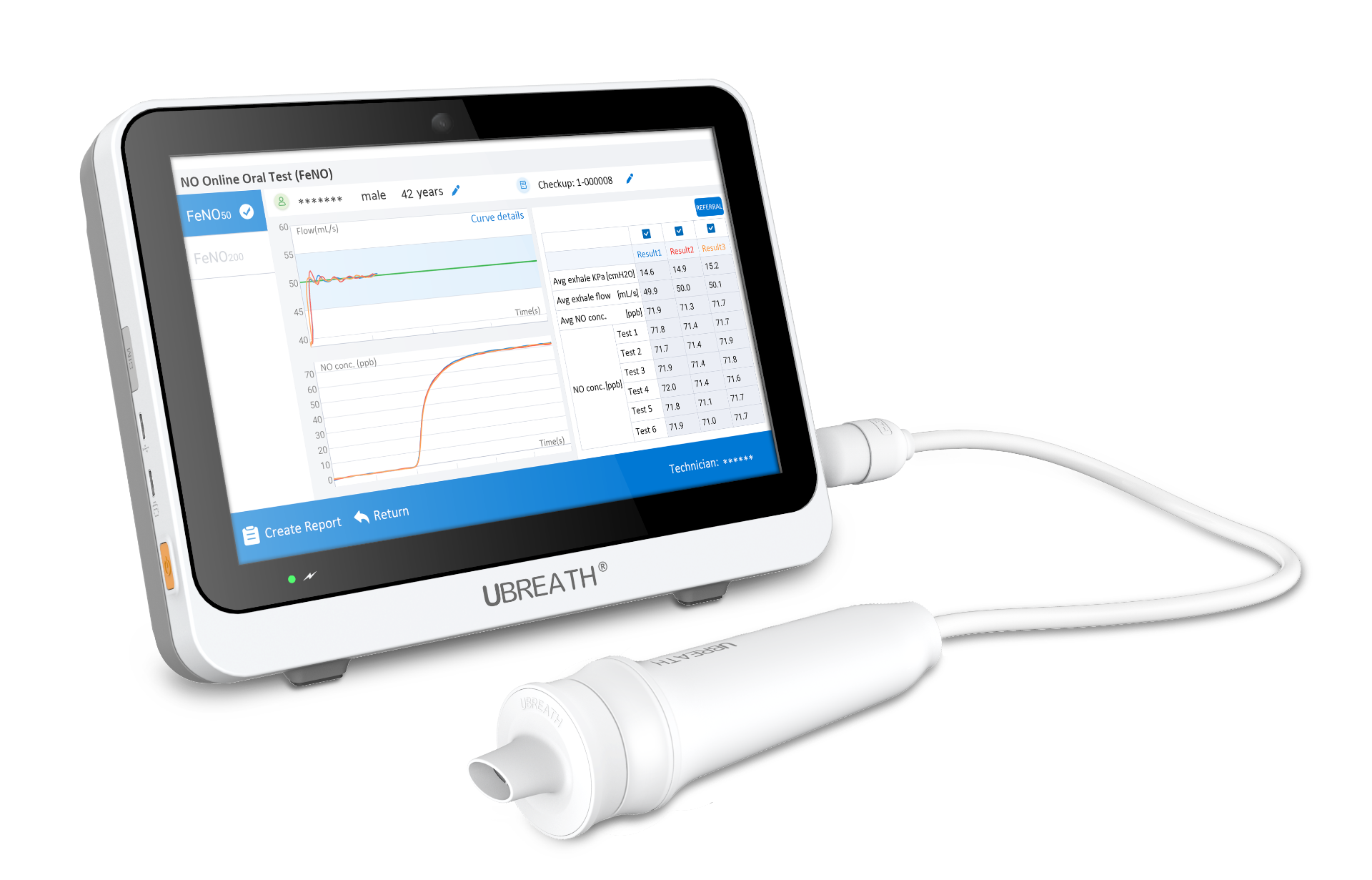
The FeNO test is remarkably straightforward. A patient takes a deep breath and exhales slowly into a handheld device for about ten seconds. The device then displays a number in parts per billion (ppb). The test requires minimal effort, takes far less time than spirometry, and can be performed in a primary care office. This ease of use makes it particularly valuable for children, who often struggle with the forced breathing maneuvers required for spirometry.
Standardization has been a key priority in recent years. The European Respiratory Society and the American Thoracic Society have established uniform measurement protocols, and a 2025 Chinese Expert Consensus further elaborated on instrument principles, detection methods, operational procedures, and quality control to promote standardized FeNO testing worldwide. The consensus also introduced multiple-flow measurements — including alveolar exhaled nitric oxide (CaNO) and FeNO at 200 mL/s flow rate — to better assess inflammation in different regions of the airways.
What the Guidelines Say
The role of FeNO in asthma diagnosis has expanded significantly in recent years. In 2025, the Global Initiative for Asthma (GINA) updated its recommendations to include elevated FeNO as a diagnostic criterion for Type 2 asthma in patients with typical symptoms when lung function testing is unavailable or inconclusive. The guideline specifies cut-off values of ≥50 ppb for adults and ≥35 ppb for children.
A 2026 update in asthma diagnosis and management further emphasized the use of FeNO testing to assess for eosinophilic airway inflammation and aid diagnosis, noting that a raised FeNO (typically defined as >50 ppb) — alongside blood eosinophil count — provides objective confirmation of the lower airway inflammation that defines asthma.
In the United Kingdom, a unified update from NICE, the British Thoracic Society, and the Scottish Intercollegiate Guidelines Network has gone even further, recommending FeNO as the first-line diagnostic test for both adults and children over five years of age. A study evaluating the impact of these guidelines in a paediatric GP clinic found that 78% of asthma diagnoses were made on the basis of elevated FeNO alone.
China has also moved decisively in this direction. The 2026 edition of the Chinese Pediatric Pulmonary Function Guidelines recommends that FeNO testing be integrated into the diagnostic pathway for childhood asthma, with particular emphasis on dynamic monitoring rather than single measurements.
How Accurate Is FeNO?
A large meta-analysis of 30 studies published in 2026 confirmed that FeNO has good diagnostic accuracy in adults, with an area under the curve (AUC) of 0.80, and fair accuracy in children (AUC 0.75). In children, a FeNO of 30 ppb or higher achieved a positive predictive value of 80%. Compared with spirometry, FeNO demonstrated superior sensitivity in children — 57% versus 52% — while maintaining high specificity of 87%.
These findings are supported by additional research. A 2025 study of diagnostic tests in children found that a FeNO threshold of 25 ppb produced the highest sensitivity (57%) while maintaining excellent specificity (94%). A separate systematic review reported a pooled sensitivity of 0.79 and specificity of 0.81 for FeNO in childhood asthma, concluding that it is most useful as an adjunct to clinical assessment and lung function testing.
Emerging evidence also points to the value of combining FeNO with other tools. A 2025 study integrating clinical phenotypes, impulse oscillometry, and FeNO into a machine learning model achieved an AUC of 0.89 for predicting asthma in preschool children — an age group where traditional spirometry is often impossible.
Important Limitations to Keep in Mind
FeNO is not a standalone diagnostic tool. Several factors can influence the results:
-
Corticosteroid use: Both inhaled and oral steroids suppress FeNO levels, so the test should ideally be performed before starting treatment. Studies with significant inhaled corticosteroid exposure show systematically lower FeNO readings, and post-hoc analyses in the 2026 meta-analysis confirmed that insufficient washout periods may underestimate diagnostic accuracy.
-
Age, sex, and device variability: FeNO levels vary substantially by age, sex, and the specific device used.
-
Non-asthma conditions: Elevated FeNO can also occur in other allergic conditions, and lower levels do not rule out asthma.
-
Diurnal variation: FeNO is lower in the morning, which may affect test interpretation.
-
The IL-5/eosinophil pathway: Because FeNO reflects IL-13-driven inflammation rather than the IL-5/eosinophil pathway, it does not fully capture all forms of Type 2 inflammation. This explains the only moderate correlation between FeNO and sputum eosinophils and why some patients with elevated eosinophils may have normal FeNO levels.
For these reasons, clinicians interpret FeNO results alongside a patient's clinical history, physical examination, and other objective tests such as blood eosinophil count or bronchodilator reversibility testing. Notably, the 2026 meta-analysis found that adding blood eosinophil count to FeNO did not significantly improve diagnostic performance, suggesting that FeNO alone may suffice as a rule-in test in many clinical settings.
Looking Ahead
As asthma care moves toward personalized, biomarker-driven management, FeNO is poised to play an even greater role. Current research is exploring its use in monitoring biologic therapies for severe asthma. Recent evidence suggests that early FeNO reduction — as early as one month after initiating biologic therapy — is associated with a higher probability of achieving clinical remission at 12 months. The ORACLE2 patient-level meta-analysis further showed that even among patients with well-controlled or seemingly "remitted" severe asthma, elevated FeNO identified residual airway inflammation not captured by symptoms or lung function alone.
In paediatric care, the future direction points toward integrating FeNO with genomics, proteomics, and other multi-omics data to build predictive models for treatment response, guiding the precise use of biologics and reducing unnecessary corticosteroid exposure. Researchers are also developing low-cost, portable FeNO devices — including smartphone-connected sensors — to enable home monitoring and remote management of chronic respiratory disease.
For patients and clinicians alike, this simple breath test represents a meaningful step toward faster, more accurate, and less invasive asthma diagnosis. From a ten-second exhalation to a personalized treatment plan, FeNO is helping to clear the air on asthma.