FeNO: The Breath Test That Measures Airway Inflammation
Introduction: A Different Kind of Breath Test
When you think of a lung test, you probably picture someone blowing hard into a spirometer—the classic pulmonary function test that measures how fast and how much air you can exhale. But there is another kind of breath test that requires you to do the opposite: breathe out slowly and steadily. It measures a gas called nitric oxide, and it is giving doctors a window into inflammation deep inside the airways.
This test is called FeNO—short for fractional exhaled nitric oxide. It is a simple, non-invasive, and quantitative way to assess a specific type of airway inflammation that plays a central role in conditions like asthma.

What Is Nitric Oxide, and Why Does It Matter?
Nitric oxide (NO) is a gas produced throughout the body by enzymes called nitric oxide synthases (NOS). It is involved in a surprising range of biological functions—from regulating blood vessel tone to serving as a signaling molecule in the nervous system. In fact, the discovery of nitric oxide's role in the cardiovascular system earned three scientists the Nobel Prize in Physiology or Medicine in 1998.
In the airways, nitric oxide has a more specific job. When the airway lining is exposed to inflammatory signals—particularly cytokines associated with allergic and eosinophilic inflammation—the enzyme inducible nitric oxide synthase (iNOS) is upregulated. This leads to the production of large amounts of NO in the exhaled breath. In other words, nitric oxide acts as a messenger that reveals inflammation in the lungs.
The type of inflammation that FeNO reflects is called type 2 inflammation. This is driven by cytokines such as IL-4 and IL-13, which are produced by T helper 2 (Th2) cells and other immune cells. Type 2 inflammation is characteristic of allergic asthma and is responsive to treatments like inhaled corticosteroids (ICS) and biologic therapies targeting the type 2 pathway.
How the FeNO Test Works
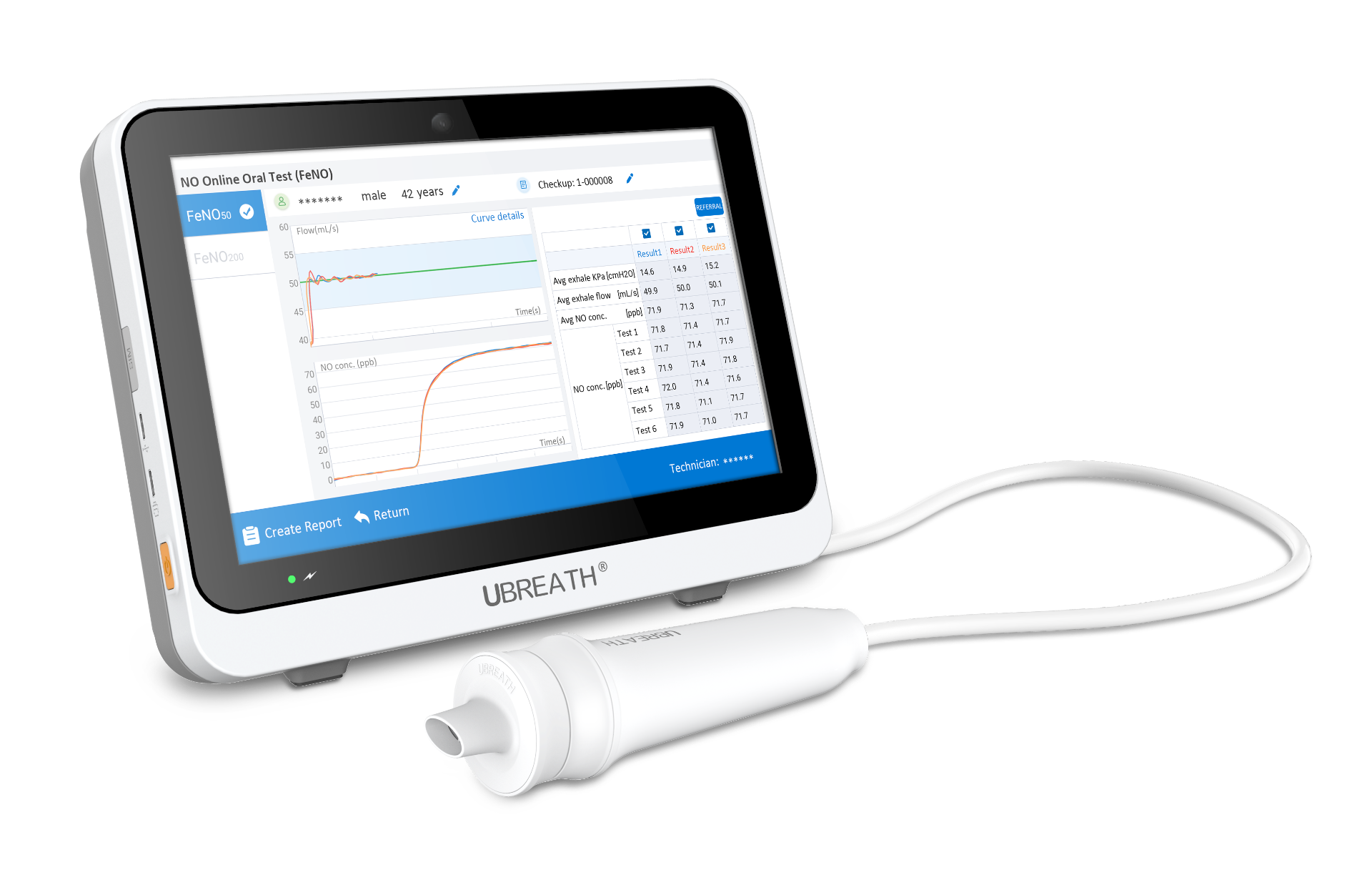
FeNO is measured during a single, controlled exhalation. You sit comfortably, take a deep breath in, and then exhale slowly and steadily into a handheld analyzer at a constant flow rate—typically 50 mL/s. The test usually takes about six to ten seconds. Importantly, you need to blow gently and steadily, not hard and fast, which is different from a conventional spirometry test.
The analyzer uses electrochemical sensors to measure the concentration of nitric oxide in your exhaled breath, expressed in parts per billion (ppb). Modern portable devices have made this test accessible in clinics, and some handheld models are now approved for home monitoring.
Standardization of the measurement method has been a major focus of international respiratory societies. The European Respiratory Society (ERS) and the American Thoracic Society (ATS) have published technical standards, and in 2025, Chinese experts released a comprehensive consensus detailing the testing process, quality control, and clinical application of FeNO.
What Your FeNO Number Means
FeNO results are interpreted using clinical cut points rather than simple “normal ranges,” because the levels are influenced by factors such as age, sex, smoking status, and the presence of allergy.
The widely used framework categorizes FeNO levels as follows:
-
Below 25 ppb (below 20 ppb in children): Eosinophilic inflammation is less likely. This is generally considered a low or normal level.
-
Between 25 and 50 ppb (between 20 and 35 ppb in children): An intermediate zone. Results in this range require interpretation in the context of clinical symptoms and other tests.
-
Above 50 ppb (above 35 ppb in children): Eosinophilic inflammation is likely, and the patient is likely to benefit from corticosteroid treatment.
The Global Initiative for Asthma (GINA) uses these same thresholds: a FeNO level above 50 ppb in adults (or above 35 ppb in children) supports a diagnosis of type 2 asthma. In adults, a FeNO level of 40 ppb or higher is approximately 90% specific for asthma diagnosis.
Where FeNO Shines: Asthma Diagnosis and Management
The most well-established application of FeNO is in asthma. Unlike spirometry, which measures lung function, FeNO measures inflammation—a distinction that matters because inflammation can be present even when lung function appears normal.
In the diagnostic pathway, guidelines from the UK’s National Institute for Health and Care Excellence (NICE) recommend using FeNO early—as a first-line test before spirometry or peak flow monitoring—in patients with symptoms suggestive of asthma. For children aged five and older, FeNO is also recommended as an initial diagnostic tool.
Beyond diagnosis, FeNO is valuable for monitoring treatment response. When a patient starts inhaled corticosteroids, FeNO levels typically fall as inflammation is suppressed. Tracking FeNO over time can help doctors determine whether the current dose is sufficient or whether it can be reduced. One study found that FeNO-guided management reduced asthma exacerbations by approximately 19% in adults. Another study showed that a FeNO-guided strategy allowed patients to use 45% less inhaled corticosteroid without an increase in exacerbations.
FeNO also has a role in predicting future risk. Higher FeNO levels over time are associated with a greater likelihood of asthma exacerbations, and combined elevation of FeNO and blood eosinophils identifies patients at particularly high risk.
Beyond Asthma: Other Respiratory Conditions
While asthma remains the primary domain for FeNO testing, research is exploring its utility in other conditions. In COPD, FeNO is not currently recommended for routine diagnosis or monitoring, but it may help identify patients with eosinophilic inflammation who could benefit from inhaled corticosteroids—a pattern sometimes described as asthma-COPD overlap. Nearly one-third of patients referred to a tertiary severe COPD clinic had FeNO levels of 25 ppb or higher, suggesting that FeNO can serve as a useful adjunct in COPD assessment.
Research is also underway to evaluate FeNO in interstitial lung disease and other respiratory conditions, though these applications are not yet part of standard clinical practice.

The Relationship Between FeNO and Blood Eosinophils
FeNO is often discussed alongside another type 2 biomarker: the blood eosinophil count (BEC). These two markers are related but distinct. FeNO reflects local, inducible nitric oxide synthase activity in the airway epithelium, driven primarily by IL-4 and IL-13. Blood eosinophils, by contrast, reflect a systemic signal driven largely by IL-5.
Because they capture different biological processes, FeNO and BEC should not be used interchangeably. Combining them provides a more complete picture of a patient's inflammatory profile. When both are elevated, the risk of exacerbations is roughly doubled compared to elevation in either marker alone.
Practical Considerations and Limitations
FeNO testing is not without its caveats. Levels can be influenced by recent food or drink consumption (nitrate-rich foods can transiently raise FeNO), respiratory infections, and smoking. Current smoking tends to lower FeNO levels, which can mask underlying inflammation.
The test is also less reliable in very young children, who may struggle to perform the required slow, steady exhalation. For children under five, tidal breathing techniques are being explored, but the evidence base is still developing.
Finally, FeNO is a marker of one specific type of inflammation—type 2/eosinophilic. It does not capture neutrophilic or mixed-pattern inflammation, which are also important in many respiratory diseases. A normal FeNO level does not rule out asthma; it simply makes eosinophilic inflammation less likely.
The Future of FeNO
The field is moving toward greater accessibility and personalization. Portable and handheld FeNO devices are making it possible to measure airway inflammation not just in specialist clinics but also in primary care and even at home. This opens the door to remote monitoring and more timely adjustments to treatment.
At the same time, research is refining how FeNO is interpreted across different populations. Reference values vary by age, sex, and geography, and ongoing studies are working to establish more precise, population-specific guidelines.
FeNO represents a shift in how we think about respiratory testing. Instead of measuring how well the lungs are working, it measures how inflamed they are—a fundamentally different question that often provides complementary and clinically actionable information. For the millions of people living with asthma and related airway diseases, this simple breath test offers a non-invasive window into a process that was once visible only through invasive procedures.
Key Takeaways
-
FeNO stands for fractional exhaled nitric oxide. It is a non-invasive breath test that measures type 2 airway inflammation.
-
The test requires a slow, steady exhalation into a handheld analyzer and takes only seconds to complete.
-
Results are interpreted using clinical cut points: below 25 ppb suggests low inflammation; above 50 ppb (or 35 ppb in children) suggests significant eosinophilic inflammation likely to respond to corticosteroids.
-
FeNO is most established in asthma diagnosis and monitoring, where it can help reduce exacerbations and optimize inhaled corticosteroid dosing.
-
Blood eosinophils and FeNO capture different aspects of type 2 inflammation and are most informative when used together.
-
Portable devices are expanding FeNO testing beyond specialist settings, and ongoing research continues to refine its clinical applications.