FeNO50 vs. FeNO200: Two Windows into Airway Inflammation
When you exhale, your breath carries far more than carbon dioxide and water vapor. It also contains trace amounts of nitric oxide (NO), a gas produced by inflamed airway tissues. Measuring the concentration of NO in exhaled breath — a test known as fractional exhaled nitric oxide (FeNO) — has become a cornerstone of non-invasive respiratory assessment. But there is a catch: the FeNO value you get depends critically on how fast you exhale. Two flow rates dominate clinical practice: 50 mL/s (FeNO50) and 200 mL/s (FeNO200). They are not interchangeable. Each captures inflammation from a different region of the respiratory tract, and understanding that difference is essential for interpreting results correctly.
A Tale of Two Flow Rates
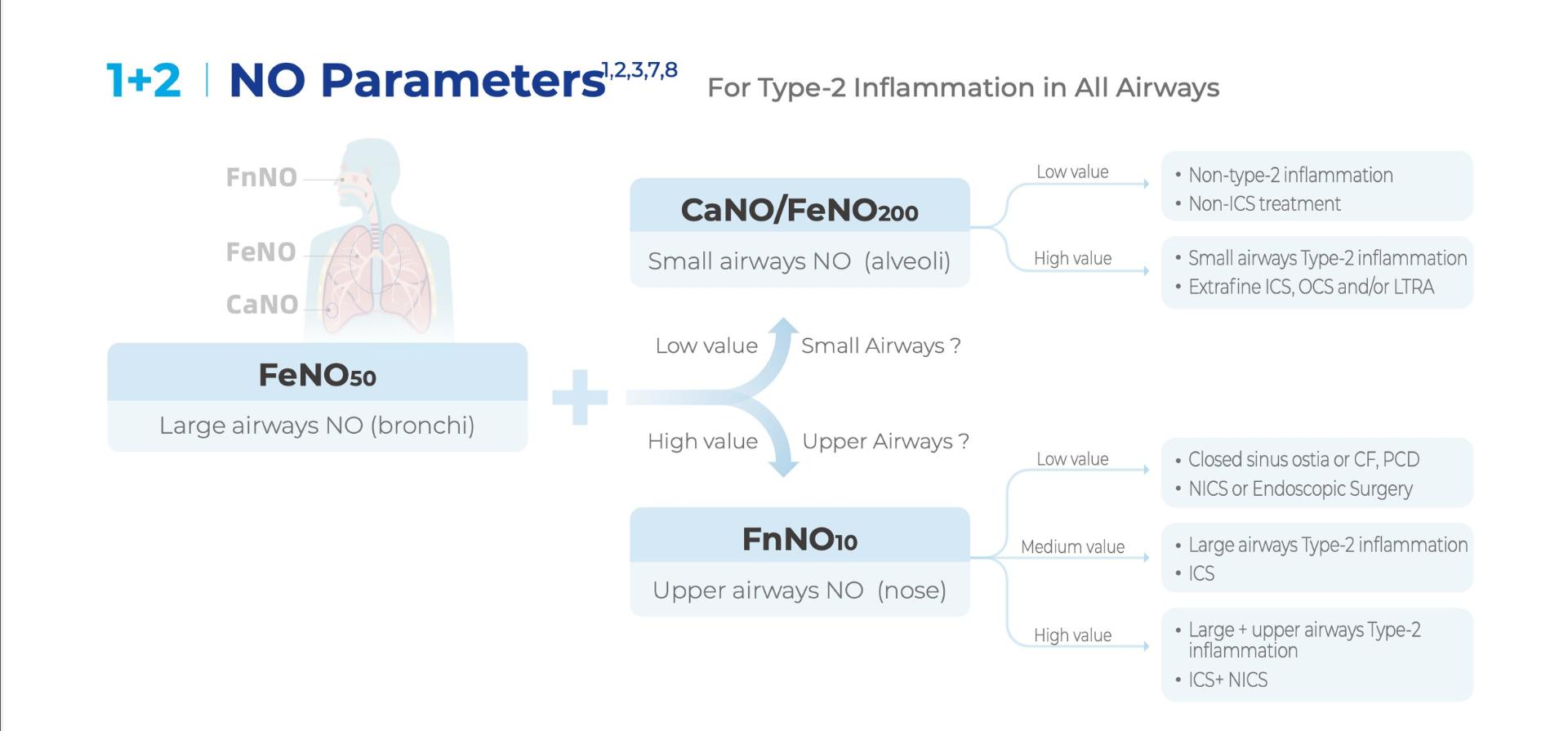
The logic behind flow-dependent FeNO measurement is rooted in the anatomy of the airways. During a slow, controlled exhalation at 50 mL/s, the air you produce spends more time in contact with the bronchial epithelium — the lining of the larger, central airways — and picks up NO generated there. FeNO50 therefore predominantly reflects large airway (bronchial) inflammation, which is the hallmark of classic allergic asthma.
Increase the exhalation flow to 200 mL/s, and the dynamics change. The faster flow reduces the residence time of air in the central airways, so less NO is picked up from that region. What you measure instead comes mainly from the peripheral small airways and alveolar region, where gas exchange occurs and where inflammation often goes undetected by conventional spirometry. In other words, FeNO50 tells you about the "trunk" of the airway tree; FeNO200 peers into its fine distal branches.
| Feature | FeNO50 | FeNO200 |
|---|---|---|
| Exhalation flow rate | 50 mL/s | 200 mL/s |
| Primary anatomical source | Large/central airways | Small airways / alveolar region |
| Typical adult normal value | <25 ppb | <10 ppb |
| Typical pediatric normal value | <20 ppb | <8 ppb |
| Key clinical associations | Asthma diagnosis, ICS responsiveness, exacerbation risk | Small airway dysfunction, CVA, COPD inflammation |
What FeNO50 Tells You
FeNO50 is the most extensively validated FeNO measurement and the one embedded in major clinical guidelines. The European Respiratory Society (ERS) specifically recommends FeNO at 50 mL/s for detecting T-helper 2 (Th2)-driven airway inflammation, and the American Thoracic Society (ATS) defines a level above 50 ppb in adults as "high," strongly suggesting active eosinophilic inflammation and likely responsiveness to inhaled corticosteroids (ICS).
Its clinical applications are well established:
-
Asthma diagnosis. A FeNO50 level of 50 ppb or higher is considered supportive of an asthma diagnosis in adults, with approximately 90% specificity in suspected cases. NICE guidelines in the UK similarly use a 50 ppb threshold as one of the objective tests for asthma diagnosis.
-
Treatment monitoring. FeNO50 responds dynamically to ICS therapy, making it useful for assessing adherence and guiding dose adjustment. A rising FeNO50 may signal impending loss of control before symptoms worsen.
-
Home monitoring. Emerging research shows that daily home FeNO50 monitoring in asthma patients reveals a significant circadian rhythm and can detect treatment response with greater sensitivity than mobile spirometry. This opens the door to real-time, personalized asthma management.
-
Distinguishing disease phenotypes. Among asthma, COPD, and asthma-COPD overlap (ACO), FeNO50 demonstrates better discriminatory ability than FeNO200 or alveolar NO (CaNO), making it the preferred single marker when the diagnostic question is "which disease?" rather than "how severe is the small airway involvement?".
FeNO50 correlates most strongly with peripheral blood eosinophil counts (r = 0.51), reinforcing its role as a systemic readout of Type 2 inflammation.
What FeNO200 Reveals
FeNO200 addresses a blind spot in respiratory medicine: the small airways. These distal passages — bronchioles less than 2 mm in diameter — contribute little to standard spirometry values like FEV₁, yet they are frequently the site of early and persistent inflammation in asthma and COPD. FeNO200 has emerged as a practical, non-invasive window into this neglected territory.
Key findings from recent research:
-
Diagnosing cough-variant asthma (CVA). In a comparative study, FeNO200 outperformed FeNO50 for diagnosing CVA (p = 0.04), with a cutoff of >11 ppb contributing strongly to differentiating CVA from other causes of chronic cough, especially in patients with small airway dysfunction.
-
Detecting airway eosinophilia. A 2026 study found that FeNO200 had superior predictive accuracy for sputum eosinophilia compared to FeNO50, with AUCs of 0.717 (for ≥2% eosinophils) and 0.743 (for ≥3% eosinophils), using cutoffs of 9.6 and 10.5 ppb respectively. Combining FeNO200 with peripheral eosinophil counts further improved diagnostic accuracy to an AUC of 0.806.
-
COPD inflammation and steroid response. FeNO200 has been proposed as a biomarker of peripheral airway inflammation in COPD and a useful tool for predicting corticosteroid therapy response. Patients with acute exacerbation of COPD (AECOPD) and FeNO200 >10 ppb appear to show a good corticosteroid response. Elevated FeNO200 levels correlate with pulmonary function impairment in both asthma and COPD.
-
Pediatric small airway dysfunction. In children with persistent small airway dysfunction (p-SAD), FeNO200 and CaNO values were significantly higher than in those without p-SAD, with median FeNO200 of 15.00 ppb in the p-SAD group. The 2021 Chinese expert consensus suggests that FeNO200 >10 ppb and/or CaNO >5 ppb may indicate a high peripheral airway inflammatory load.
The Practical Divide: When to Use Which
The choice between FeNO50 and FeNO200 is not a matter of one being "better" — it is a matter of matching the measurement to the clinical question.
Use FeNO50 when you need to:
-
Screen for or confirm classic allergic (Type 2) asthma
-
Assess ICS responsiveness and guide steroid therapy
-
Monitor asthma control over time, including at home
-
Distinguish asthma from COPD and ACO
Use FeNO200 when you need to:
-
Investigate suspected small airway involvement, especially in CVA or early COPD
-
Evaluate persistent symptoms despite normal or near-normal spirometry
-
Predict corticosteroid response in COPD patients
-
Assess peripheral airway inflammation in children with allergic asthma, particularly those with inhalant or mixed sensitization
In practice, many clinicians now measure both. The pattern of FeNO50 versus FeNO200 can reveal whether inflammation is predominantly central or peripheral — a distinction with real therapeutic implications. A patient with elevated FeNO50 but normal FeNO200 may have classic bronchial asthma responsive to standard ICS. A patient with the reverse pattern may have small airway-predominant disease that requires a different treatment approach or more aggressive targeting of the distal airways.

Measurement Matters
One caveat deserves emphasis. FeNO50 is a standardized measurement with well-defined reference values and established quality control procedures. FeNO200, by contrast, lacks universally accepted reference ranges, and the ERS has noted this gap explicitly. Clinicians interpreting FeNO200 should be aware that the evidence base, while growing rapidly, is younger and less harmonized than that for FeNO50.
Proper technique is critical for both. Patients should avoid eating, drinking caffeinated beverages, smoking, and strenuous exercise for at least one hour before testing. Nitrate-rich foods (such as lettuce, spinach, and processed meats) should be avoided for three hours prior, as they can artificially elevate NO levels. Exhalation flow must be controlled precisely — even minor deviations from the target rate can affect diagnostic validity.
The Bottom Line
FeNO50 and FeNO200 are complementary tools, not competing ones. FeNO50 offers a well-validated, guideline-endorsed measure of large airway Type 2 inflammation that is central to asthma diagnosis and management. FeNO200 opens a window into the small airways — a region that spirometry often misses but where inflammation can silently drive disease progression. Together, they provide a more complete picture of what is happening inside the lungs than either measurement alone can achieve. As research continues to refine cutoff values and expand clinical applications, the combined use of flow-dependent FeNO measurements is likely to become standard practice in personalized respiratory care.