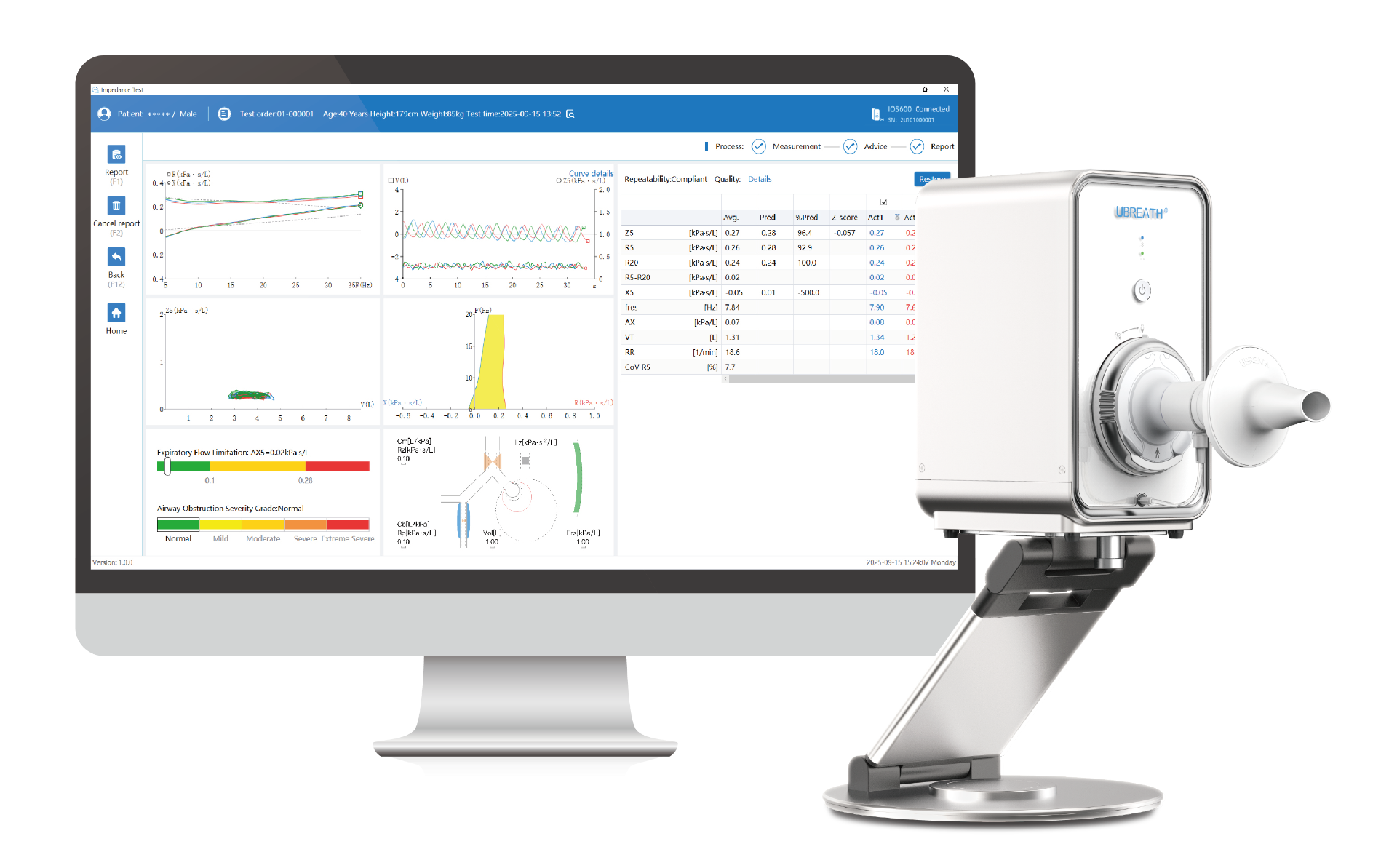
Impulse Oscillometry (IOS): The Sound Wave Revolution in Lung Testing
What Is Impulse Oscillometry?
Imagine a lung function test that requires nothing more than sitting still and breathing normally. That is precisely what Impulse Oscillometry (IOS) offers—a quiet, non-invasive technology that uses sound waves to map the health of your airways in seconds.
First described by Dubois over 50 years ago as a variant of the forced oscillation technique, IOS has evolved into a sophisticated tool that measures respiratory mechanics without the exhausting effort demanded by traditional tests. Instead of asking patients to blow forcefully into a machine, IOS simply listens to how sound waves travel through the lungs during normal, tidal breathing.
How Does It Work?
The principle is surprisingly elegant. A loudspeaker-like device generates gentle pressure pulses—sound waves—that are superimposed on the patient's natural breathing pattern through a mouthpiece. As these sound waves travel through the respiratory tree, they encounter resistance from airway walls and reflect back. Sensitive pressure-flow transducers measure these returning signals, allowing the system to calculate two key parameters:
-
Resistance (R) – the friction air encounters as it moves through the airways
-
Reactance (X) – the elasticity and recoil of the lungs, particularly in the small airways
What makes IOS particularly powerful is its use of multiple frequencies. Lower frequencies, such as 5 Hz, travel deep into the distal (small) airways, while higher frequencies, like 20 Hz, are absorbed or reflected by the larger central airways. This frequency-dependent analysis creates a high-resolution map of airway function, pinpointing exactly where abnormalities exist.

Why IOS Matters: The Patient-Friendly Revolution
No More Forced Maneuvers
Traditional spirometry requires patients to inhale deeply and exhale as hard and fast as possible—a maneuver that can be exhausting, distressing, or simply impossible for many people. Children, the elderly, and those with severe respiratory conditions often struggle to produce reliable results.
IOS eliminates this barrier entirely. Patients simply sit comfortably, wear a nose clip, and breathe naturally through a mouthpiece for about 30 seconds. The test is repeated at least three times to ensure accuracy, with the entire procedure taking roughly ten minutes. Even children as young as three years old can complete the test successfully.
Unmasking the "Silent Zone"
Perhaps the most compelling advantage of IOS is its ability to detect small airway disease—often called the "silent zone" of the lung. Significant damage can accumulate in the peripheral airways long before traditional spirometry shows any decline in standard metrics like FEV1 or FVC. Because low-frequency sound waves penetrate these distal regions, IOS can identify early changes in conditions like asthma and COPD before symptoms even appear.
Clinical Applications
IOS has proven valuable across a wide range of respiratory conditions:
-
Asthma – IOS parameters can detect early loss of control in asthmatic patients, often outperforming spirometry in predicting exacerbations
-
COPD – The test can identify early airway disease in smokers, potentially enabling earlier intervention
-
Pediatric Respiratory Conditions – IOS is particularly suited for children who cannot perform traditional tests
-
Bronchodilator and Bronchoprovocation Testing – The test effectively measures responses to medication and airway challenges
The technology has also found use in COVID-19 research, helping evaluate lung function in recovered patients.
IOS on the iOS Platform
The portability and digital nature of modern IOS devices have made them natural candidates for integration with mobile health platforms. Several iOS applications now support oscillometry-based lung function testing, bringing this technology into clinics and potentially into home monitoring.
The PulmoScan Clinic App, for example, connects to the world's first portable, wireless Forced Oscillation Technique device—FDA-cleared for both clinic and home use. Similarly, the ALDS (Ambulatory Lung Diagnostic System) app combines oscillometry, FeNO (fractional exhaled nitric oxide), and spirometry in a single iOS-compatible platform, enabling comprehensive respiratory assessment with cloud-based algorithms that evaluate measurement data alongside patient history.
These mobile applications allow healthcare providers to manage multiple patients, export results to PDF, share reports, and even communicate with patients directly through the app. The integration of AI-based quality checks ensures that measurements meet professional standards like the ATS/ERS 2019 guidelines.
What to Expect During an IOS Test
For patients undergoing an IOS test, the experience is straightforward and comfortable:
-
You sit at the equipment in a relaxed position with your head in a neutral or slightly extended position
-
A nose clip is placed to ensure all breathing occurs through the mouth
-
You breathe normally through a mouthpiece attached to the loudspeaker for about 30 seconds
-
A physiologist may gently support your cheeks to ensure accurate measurements
-
The test is repeated a minimum of three times
The pressure waves may feel slightly strange—you will hear vibrations from the loudspeaker and feel them in your chest—but they cause no harm. Some people report mild chest tightness during the test, which typically eases within two minutes of rest. There are no adverse effects associated with IOS testing.
The Future of Respiratory Diagnostics
As portable IOS devices become more accessible and iOS-compatible applications continue to evolve, this sound wave technology is poised to transform respiratory care. Its ability to provide detailed, effort-independent lung function data makes it an invaluable tool for diagnosing and monitoring respiratory diseases across all age groups—from young children to the elderly.
In an era where early detection is increasingly recognized as the key to better outcomes, IOS offers something traditional tests cannot: a window into the quiet zone of the lung, revealing problems before they become symptomatic. And with the power of iOS bringing this technology to more clinicians and patients, the future of lung health looks clearer than ever.