Fractional Exhaled Nitric Oxide (FeNO): Reading the Number in the Context of Pulmonary Function Testing
A pulmonary function report tells you how well air moves in and out of the lungs. A FeNO result tells you something different: how much type 2–driven inflammation is likely present in the airways. When the two are read together, the FeNO number becomes far more useful than either test alone.

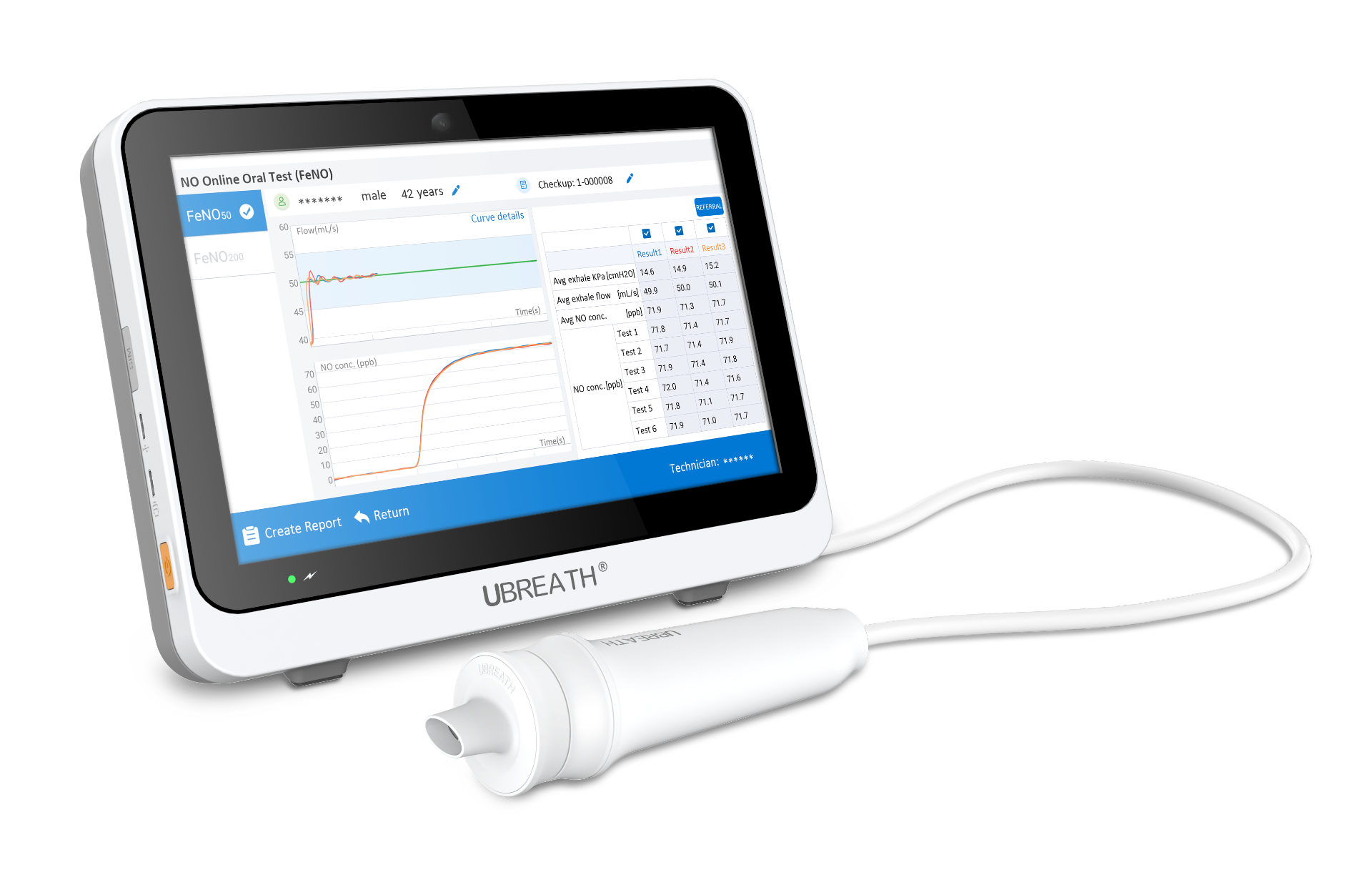
What FeNO actually measures. FeNO stands for the fractional concentration of exhaled nitric oxide, expressed in parts per billion (ppb). The nitric oxide is produced largely by inducible nitric oxide synthase in airway epithelial cells, a process driven by type 2 cytokines such as IL-13. A higher FeNO therefore points toward ongoing type 2 airway inflammation and, in the right clinical setting, a greater likelihood of corticosteroid responsiveness. Unless otherwise specified, the standard measurement is FeNO₅₀—exhaled oral nitric oxide at a flow rate of 50 mL/s.
The thresholds are not the same for adults and children. The most widely used framework comes from the American Thoracic Society and the European Respiratory Society. In adults, a FeNO below 25 ppb makes eosinophilic inflammation and corticosteroid responsiveness less likely; a value above 50 ppb makes them probable. Values between 25 and 50 ppb are intermediate and should be interpreted with caution. In children, the corresponding cut-offs are lower: below 20 ppb is considered low, above 35 ppb high, and 20–35 ppb intermediate. Some sources place the adult “normal” upper limit at 20–25 ppb, and the childhood normal upper limit at 15–20 ppb, reflecting the fact that exact cut-offs vary slightly with age, height and sex.
The same number can mean different things depending on the clinical question. In a treatment-naïve patient with suspected asthma, a high FeNO supports the diagnosis and suggests that inhaled corticosteroids (ICS) are likely to work; a low FeNO argues against a type 2–driven process and prompts consideration of alternative diagnoses. In a patient with an established asthma diagnosis who is already on treatment, a persistently high FeNO raises different questions: adherence, inhaler technique, ongoing allergen exposure, and the possibility of ICS-resistant inflammation requiring add-on therapy. A low FeNO in a treated patient is more reassuring that type 2 inflammation is under control. This is why FeNO is best used as a longitudinal marker—a change from a patient’s own stable baseline can carry more information than a single reading against a population cut-off.
Several common factors can move FeNO in the “wrong” direction. Current cigarette smoking suppresses FeNO, by roughly 30–60% depending on daily cigarette consumption, through downregulation of inducible NO synthase. Atopy, allergic rhinitis, nasal polyposis and recent viral respiratory infection tend to raise FeNO. Inhaled corticosteroids lower it, which is precisely the point therapeutically but complicates interpretation if the test is ordered without knowing the treatment status. Forced spirometry itself can transiently reduce exhaled NO, so FeNO is generally better measured before spirometry rather than after. Nitrate-rich foods can raise FeNO by 40–60%, peaking 1–2 hours after intake, and smoking or eating within the hour before testing can distort the result.
Technical quality matters as much as the number. ATS/ERS standards call for repeated exhalations, with at least two acceptable FeNO values differing by less than 10%; the reported value is the mean. The exhalation must be maintained at 50 mL/s, because faster flow rates lower the measured NO concentration and make results incomparable. A report should therefore show not only the ppb value but also the flow–time and concentration–time curves, so the reader can judge whether the plateau was stable and the maneuver reproducible.
Where FeNO fits—and where it does not. FeNO is best established in asthma, where it helps rule type 2 inflammation in or out and predicts corticosteroid responsiveness. It is also increasingly studied in chronic cough, where an elevated FeNO can point toward cough-variant asthma or non-asthmatic eosinophilic bronchitis, and in COPD, where a subset of patients shows raised FeNO and may represent a treatable eosinophilic phenotype. What FeNO does not do is replace spirometry, bronchodilator reversibility testing, or clinical judgment. It is an adjunctive biomarker: useful when the pretest probability is already being shaped by symptoms, history and lung function, and misleading when treated as a stand-alone diagnostic label.
The practical takeaway is simple: read FeNO as a context-dependent inflammatory signal, not a fixed diagnostic verdict. Note the patient’s age, smoking status, atopy history, corticosteroid use and the timing of the test relative to spirometry. Compare the value with the patient’s own previous readings when possible. Used this way, FeNO adds a dimension to pulmonary function testing that spirometry alone cannot provide—an estimate of the inflammatory “weather” in the airways, alongside the mechanical “climate” that lung function already describes.