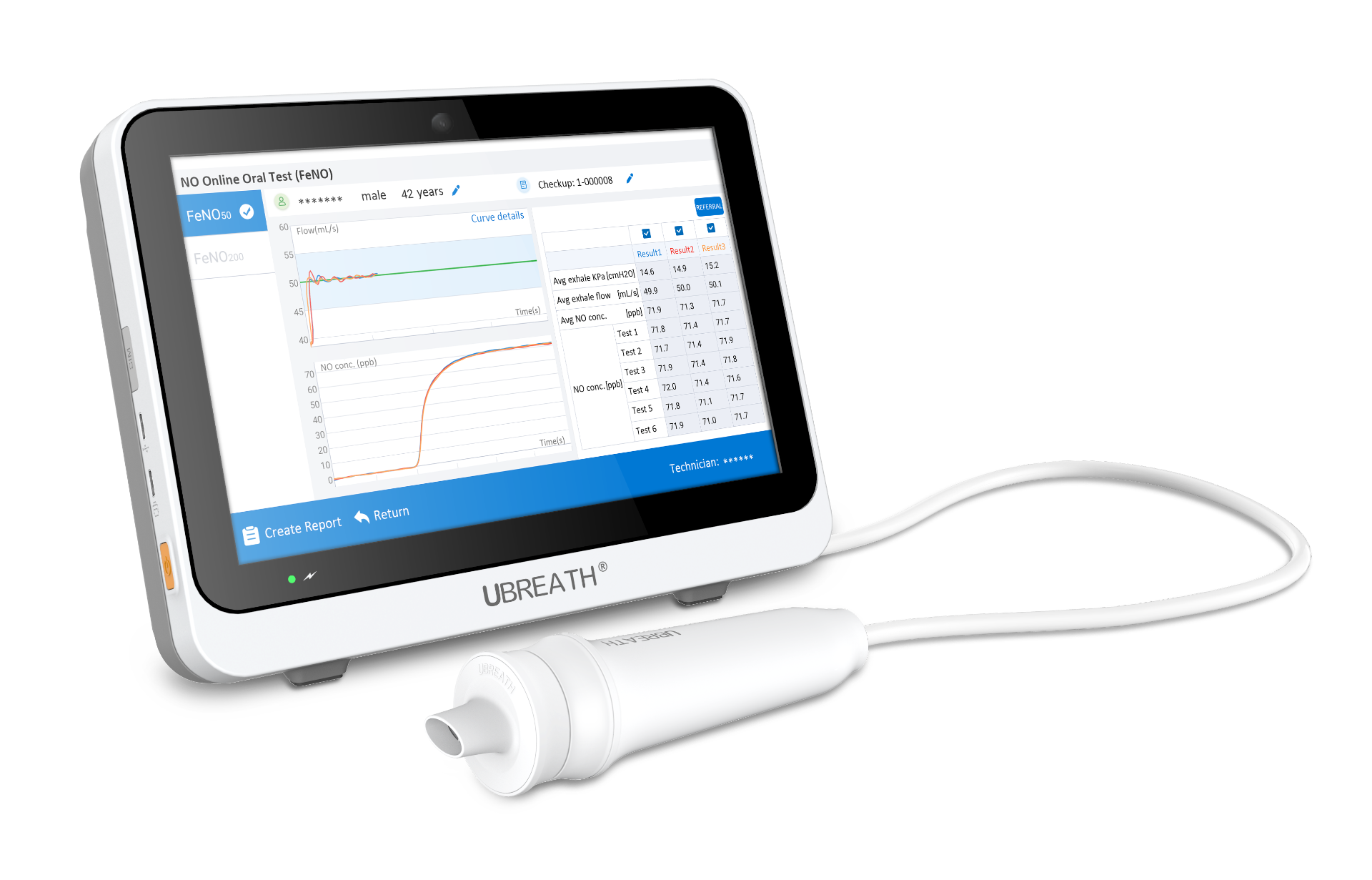
Why the Way You Blow Determines What the Test Measures: A Patient’s Guide to Flow Rate in FeNO Testing
If your doctor has ordered a FeNO test, you will be asked to blow into a handheld device “slowly and steadily” for about ten seconds. That instruction is not a casual suggestion. The speed of your breath—the exhalation flow rate—is the single most important technical factor that determines whether the FeNO number reflects inflammation in your large airways, your small airways, or somewhere in between.
This article explains why flow rate matters, what the standard 50 mL/s flow rate actually measures, and what you need to do to give a reliable sample.
Two airways, two sources of nitric oxide
Your respiratory tract is not a single uniform tube. It is divided into an upper airway (nose, sinuses, pharynx) and a lower airway (trachea, bronchi, bronchioles, and alveoli). Nitric oxide (NO) is produced throughout this system, but the concentration and the biological meaning of that NO differ by location.
In the lower airway, NO is generated largely by bronchial epithelial cells, and its concentration rises when the airways are inflamed—particularly in eosinophilic inflammation, the pattern commonly seen in asthma. This is the signal FeNO is designed to capture.
The problem is that NO from the upper airway is also present, and nasal NO concentrations can be many times higher than those in the lower airway. If nasal NO leaks into the sample, the FeNO reading becomes falsely elevated. A properly performed FeNO test therefore has two jobs: exclude upper-airway NO and sample the lower airway at a defined depth.
Why flow rate is the “selector” for airway depth
Here is the key physiological fact: FeNO is highly flow-dependent. Higher exhalation flows produce lower FeNO values, and lower flows produce higher values. This is not a flaw in the test—it is a window into where the NO is coming from.
When you exhale slowly, the air spends more time in contact with the airway wall. NO from the small airways and alveoli—the peripheral, “deep” compartments of the lung—has more time to diffuse into the exhaled breath. The resulting FeNO value is therefore a mixture of large-airway and peripheral contributions.
When you exhale faster, the contact time is shorter. The NO that reaches the mouth comes predominantly from the large airways (the bronchi), because the peripheral contribution is “washed out” or has less time to accumulate. In other words, flow rate acts like a depth selector: low flow samples more of the lung periphery, high flow samples more of the proximal bronchial tree.
The standard: 50 mL/s and what it represents
International guidelines from the American Thoracic Society (ATS) and the European Respiratory Society (ERS) standardized FeNO measurement at an exhalation flow rate of 50 mL per second (50 mL/s). This is often written as FeNO₅₀.
The choice of 50 mL/s was a deliberate compromise. It is slow enough to be comfortable for most patients, including children, yet fast enough to provide a stable, reproducible signal that primarily reflects bronchial (large-airway) NO production rather than peripheral or alveolar NO. The 1999 ATS guideline described 50 mL/s as an “optimal compromise between measurement sensitivity and patient tolerability”. Modern consensus recommendations allow a practical tolerance of 45–55 mL/s (±10%) during the maneuver.
At this flow, the test is considered a marker of large-airway eosinophilic inflammation—the component most closely linked to asthma diagnosis and steroid responsiveness in many patients.
What about the small airways? The role of 200 mL/s
The same physiology that makes 50 mL/s a large-airway signal also opens the door to assessing the small airways by using a higher flow rate. At 200 mL/s—labeled FeNO₂₀₀—the peripheral contribution is further suppressed, and the measurement is thought to more selectively reflect small-airway inflammation.
FeNO₂₀₀ is an emerging tool rather than a routine replacement for FeNO₅₀. Recent research suggests that FeNO₂₀₀ may improve the detection of airway eosinophilia in some patients, especially when combined with blood eosinophil counts. But the clinical standard for everyday FeNO testing remains the 50 mL/s maneuver. If your clinician mentions “FeNO” without specifying a flow rate, they almost always mean FeNO₅₀.
The maneuvers that make 50 mL/s work: soft palate and resistance
Maintaining 50 mL/s is not just about blowing at the right speed. Two mechanical details are essential for a valid lower-airway sample.
1. Soft palate closure. The soft palate (velum) separates the nasal cavity from the oral cavity. If it remains open during exhalation, nasal NO can be drawn into the mouthpiece and contaminate the reading. Exhaling against a resistance—typically a pressure of about 5–20 cmH₂O—helps keep the soft palate closed. Many modern FeNO devices build this resistance into the mouthpiece or provide flow-incentive feedback so that the patient generates the required pressure without thinking about it.
2. A stable plateau. The FeNO value is not read from the first burst of air. After dead-space air is cleared, the NO concentration rises to a plateau—a relatively flat phase of steady NO output. Guidelines require averaging the signal over a plateau of at least 3 seconds, with variation between points kept below about 10%. This is why the test lasts 6 to 10 seconds: the device needs enough stable signal to identify the plateau and calculate a reliable mean.
What you actually do during the test
The patient instructions are simple, but the sequence matters:
-
Sit upright and rest. Avoid eating, drinking, smoking, or vigorous exercise for at least one hour before the test. Nitrate-rich foods (leafy greens, processed meats) can also influence NO levels and are often avoided for several hours beforehand.
-
Exhale fully to empty your lungs.
-
Inhale deeply through the device filter to total lung capacity. This takes about 2–3 seconds.
-
Exhale slowly and steadily into the mouthpiece, following the device’s flow indicator (often an on-screen animation or a sound). The target is a constant 50 mL/s. Do not blow hard or fast—this is a gentle, controlled exhalation, not a forced spirometry maneuver.
-
Keep going for 6–10 seconds (adults and older children typically 10 seconds; younger children may use a 6-second mode) until the device signals that the plateau has been captured.
If the flow is too high or too low, the device will usually reject the attempt and ask you to try again. Two acceptable measurements are typically averaged, with a 4–5 minute interval between them.
Common misconceptions, clarified
“I should blow as hard as I can.” No. FeNO is not a lung-function (spirometry) test. Forced, fast exhalation will lower the FeNO value and may prevent a stable plateau. The correct effort is slow, steady, and gentle.
“A higher number must mean worse inflammation.” Not necessarily. FeNO is flow-dependent: a value obtained at 50 mL/s cannot be directly compared with a value obtained at a different flow. The number is only interpretable in the context of the standardized 50 mL/s maneuver and the reference range for your age and clinical context.
“If my FeNO is normal, my small airways are fine.” FeNO₅₀ primarily reflects large-airway inflammation. Normal FeNO₅₀ does not rule out small-airway disease; that is one reason researchers are studying FeNO₂₀₀ and other multiple-flow methods.
The bottom line
Flow rate is not a technical footnote in FeNO testing—it is the defining variable that determines what the test is actually measuring. The standardized 50 mL/s exhalation is designed to sample large-airway bronchial NO while excluding nasal contamination and minimizing peripheral “dilution.” Achieving that flow requires a slow, steady exhalation against mild resistance, sustained long enough to capture a stable plateau. When the maneuver is performed correctly, FeNO becomes a reproducible, noninvasive window into eosinophilic airway inflammation—and a number your clinician can trust.