World Lung Function Day: Why Your Breathing Deserves Attention
Every year on June 27th, the global health community observes World Lung Function Day — a day dedicated to raising awareness about the importance of lung health and the early detection of respiratory diseases. Established by the International Respiratory Forum and the European Lung Foundation in collaboration with national pulmonary societies worldwide, this day serves as a crucial reminder: monitoring your lung function should be as routine as checking your blood pressure.
The Silent Crisis of Declining Lung Health
Our lungs are remarkable organs. By the age of 20 to 25, lung function reaches its peak — and from there, it naturally begins a gradual decline of approximately 1% per year after age 30. However, this decline can accelerate dramatically due to smoking, air pollution, occupational exposure to dust and chemicals, and recurrent respiratory infections. The challenge is that early-stage lung damage often presents no obvious symptoms. Conditions like chronic obstructive pulmonary disease (COPD), which affects nearly 100 million people in China alone and over 400 million worldwide, are frequently diagnosed only at a moderate or severe stage, when irreversible damage has already occurred and treatment options become far more limited. As the World Health Organization warns, COPD is projected to become the third leading cause of death globally by 2030.
This is precisely why World Lung Function Day emphasizes proactive testing. A simple, safe, and quick spirometry test can detect abnormalities long before you feel short of breath. It is the "gold standard" for diagnosing COPD and is essential for managing asthma, pulmonary fibrosis, and other respiratory conditions. Yet shockingly, studies suggest that over 70% of people with early-stage COPD are unaware of their condition — a gap that this awareness day seeks to close.
Beyond Spirometry: The Role of FeNO Testing
While traditional lung function tests measure how much and how fast you can breathe out (forced vital capacity and forced expiratory volume in one second), they do not tell the whole story. These mechanical measurements cannot distinguish between different types of airway obstruction or reveal the underlying inflammatory state of the lungs. This is where FeNO testing becomes an indispensable complement.
What Is FeNO?
FeNO stands for Fractional Exhaled Nitric Oxide. Nitric oxide (NO) is a gaseous signaling molecule produced naturally by the epithelial cells lining your airways. In healthy individuals, NO levels are relatively low and stable. But when your airways are inflamed — particularly in type-2 (eosinophilic) inflammatory conditions such as allergic asthma, atopic dermatitis, and allergic rhinitis — the cells lining the airways produce significantly more NO under the influence of inflammatory cytokines like interleukin-4, interleukin-5, and interleukin-13.
How Is the Test Performed?
The FeNO test is as simple as it is insightful:
-
You sit comfortably and take a deep, full breath.
-
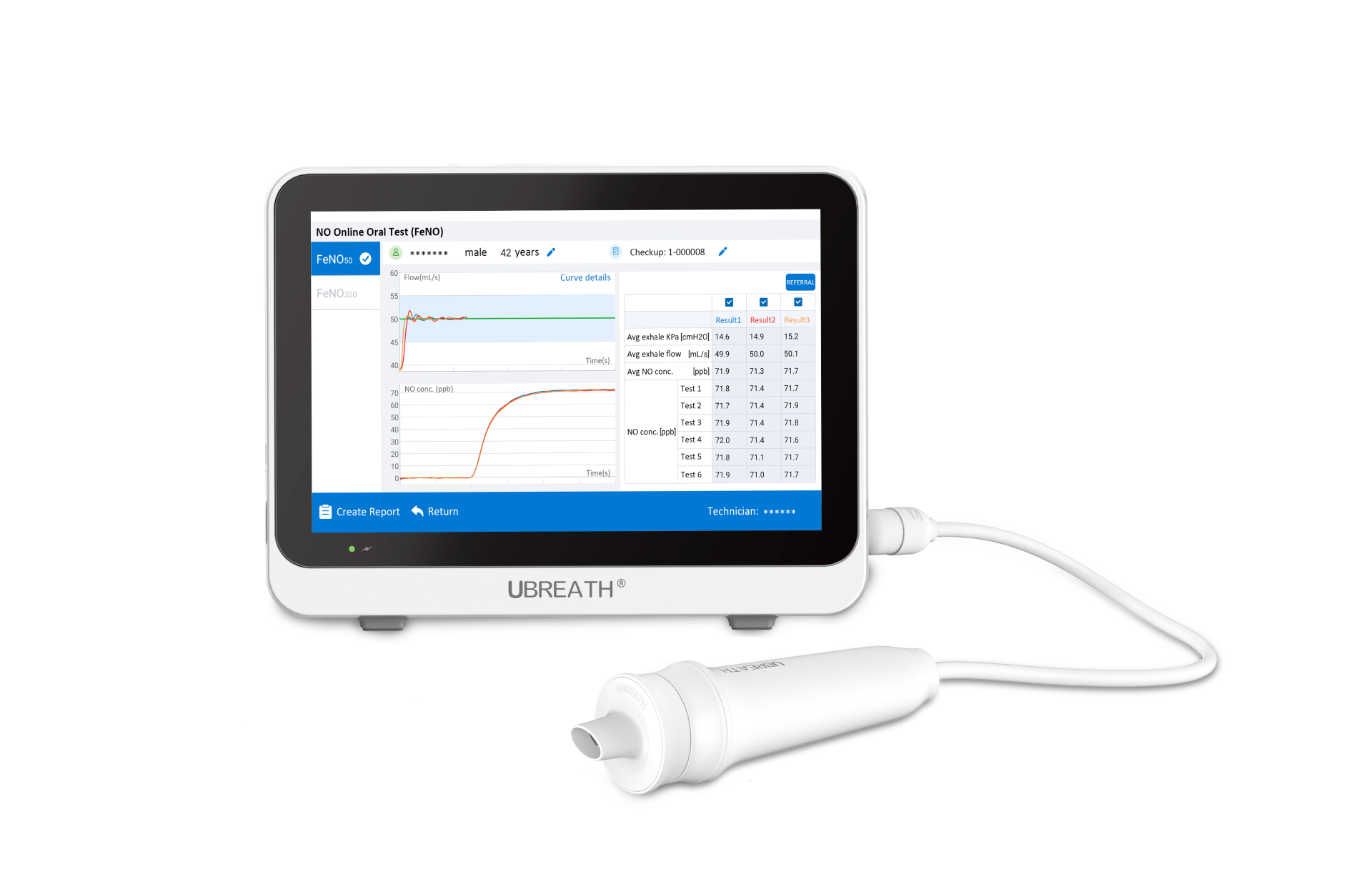
You exhale slowly and steadily into a specialized handheld device at a controlled flow rate of 50 mL/s for approximately 10 seconds.
-
The machine instantly measures the concentration of NO in your breath (measured in parts per billion, or ppb) and displays the result within one minute.
This non-invasive, painless, and rapid (3–5 minutes) procedure requires no needles, no fasting, and no exposure to radiation. It is suitable for adults, school-aged children, and even some preschool children with appropriate coaching. Importantly, the test requires you to avoid certain factors beforehand — such as smoking, eating nitrate-rich foods (like spinach or beets), or drinking alcohol — as these can temporarily affect NO levels. Typically, clinicians recommend refraining from these activities for at least one hour before testing.
Why FeNO Matters: Five Key Clinical Insights
FeNO testing has become a vital tool in modern respiratory medicine, endorsed by the Global Initiative for Asthma (GINA) guidelines and the American Thoracic Society (ATS) . Here is why it has gained such prominence:
1. Guiding Asthma Diagnosis and Confirming Phenotypes
Asthma is not a single disease but a syndrome with multiple underlying mechanisms. A high FeNO level indicates significant type-2 airway inflammation, suggesting that a patient is likely to respond well to inhaled corticosteroids (ICS). A landmark meta-analysis published in the Journal of Allergy and Clinical Immunology reported that FeNO has good diagnostic accuracy for asthma (AUC 0.80), with a threshold above 46 ppb offering high specificity (over 90%) for the condition. In cases where spirometry results are normal or equivocal — which happens in many patients with mild or well-controlled asthma — an elevated FeNO can provide the crucial diagnostic clue that tips the balance toward an asthma diagnosis.
2. Assessing Treatment Adherence and Predicting Exacerbations
Perhaps the most practical value of FeNO lies in longitudinal monitoring. A patient whose ICS treatment is working effectively will typically show a 20–30% reduction in FeNO within 2 to 4 weeks of starting therapy. Conversely, rising FeNO levels in a previously stable patient often signal:
-
Poor medication adherence (the most common cause of asthma control failure)
-
Inadequate inhaler technique (leading to reduced drug delivery)
-
Worsening underlying inflammation that may precede an exacerbation by several weeks
Studies have demonstrated that FeNO-guided management can reduce asthma exacerbation rates by approximately 30–40% compared to standard symptom-based management, particularly in children and young adults.
3. Distinguishing Between Inflammatory Phenotypes
Not all respiratory symptoms are caused by the same type of inflammation. FeNO helps clinicians differentiate:
-
Eosinophilic (type-2) inflammation (high FeNO) — responsive to corticosteroids, commonly seen in allergic asthma
-
Neutrophilic inflammation (normal or low FeNO) — often associated with smoking-related COPD, pollution exposure, or bacterial infections, which may require different therapeutic approaches (bronchodilators or antibiotics rather than high-dose steroids)
This distinction is clinically critical, as unnecessary high-dose steroid use in non-eosinophilic patients carries significant side effects without meaningful benefit.
4. Interpreting the Numbers: A Practical Guide
Different FeNO levels guide clinical decisions, though thresholds vary slightly by age and clinical context:
| FeNO Level (ppb) | Adults | Children (6–17 years) | Clinical Interpretation |
|---|---|---|---|
| Low | < 25 | < 20 | Little or no type-2 inflammation; eosinophilic asthma unlikely |
| Intermediate | 25–50 | 20–35 | Some inflammation present; consider clinical correlation and repeat testing |
| High | > 50 | > 35 | Significant type-2 inflammation; likely responsive to ICS therapy |
Note: Smokers and individuals with certain genetic polymorphisms (e.g., in the NOS2 gene) may have lower baseline FeNO levels, so results should always be interpreted by a clinician in the full clinical context.
5. A Complement, Not a Replacement
It is important to emphasize that FeNO is not a standalone diagnostic tool — it is one piece of a larger puzzle. The complete respiratory evaluation should include:
-
A thorough medical history (family history of asthma or allergies, occupational exposures, smoking history)
-
Physical examination (auscultation for wheezing or crackles)
-
Spirometry with bronchodilator reversibility testing (to assess airflow obstruction and its reversibility)
-
In some cases, bronchial provocation testing, peak flow monitoring, or imaging studies
Airway caliber (how open the airways are) can affect FeNO levels, and results can be influenced by recent respiratory infections, exercise, or dietary factors. Thus, the diagnostic power of FeNO is maximized when combined with other objective measures.
Who Should Get Tested?
World Lung Function Day encourages everyone to prioritize their lung health, but certain populations are at higher risk and should be particularly vigilant. Experts recommend that people aged 40 and above, especially current or former smokers (including those who have quit within the past 10 years), should have their lung function tested annually — just like a blood pressure or cholesterol check.
You should consider both spirometry and FeNO testing if you:
-
Have a chronic cough lasting more than 8 weeks, with or without phlegm
-
Experience unexplained shortness of breath during everyday activities (e.g., climbing stairs) or at rest
-
Suffer from recurrent wheezing or chest tightness
-
Have been diagnosed with asthma or COPD — to monitor disease activity and guide treatment adjustments
-
Have a personal or family history of allergies, atopic dermatitis, or allergic rhinitis (commonly linked to type-2 inflammation)
-
Are an occupational worker exposed to dust, fumes, chemicals, or biological agents (e.g., construction workers, miners, textile workers, healthcare staff exposed to cleaning agents)
-
Are a former smoker who has quit but worries about hidden lung damage
The Cost-Effectiveness and Accessibility of FeNO
One frequent misconception is that advanced pulmonary testing is expensive or available only in major hospitals. In reality, FeNO analyzers have become increasingly compact, affordable, and user-friendly. Portable devices are now available for use in primary care clinics, community health centers, and even some pharmacies. In many healthcare systems, FeNO testing is covered by health insurance or available at a modest out-of-pocket cost comparable to a standard laboratory blood test.
From a health-economic perspective, FeNO-guided asthma management has been shown to be cost-effective in multiple studies, primarily by reducing emergency department visits, hospitalizations, and unscheduled physician consultations. For a chronic condition like asthma, which accounts for substantial healthcare expenditure worldwide, a 30% reduction in exacerbations translates into significant savings for both patients and healthcare systems.
A Call to Action: Make June 27th the Day You Prioritize Your Lungs
Your lungs are the engine of your life. They work tirelessly, breathing over 20,000 times a day and processing approximately 10,000 liters of air daily. Yet unlike cardiovascular health — which receives constant public attention through blood pressure screenings and cholesterol checks — lung health remains tragically overlooked. This June 27th, take a moment to think about them. Whether you feel perfectly healthy or are experiencing subtle symptoms, a lung function test combined with FeNO measurement can provide invaluable insights into your respiratory well-being.
Don't wait for the "silent killer" to speak. Make a commitment to test your lungs. It is simple, it is fast, it is painless, and it could save your breath — and your quality of life — for years to come.