The Critical Role of Exhalation Flow Rate in FeNO Testing: How the BA200 Ensures Guideline‑Compliant Measurements
Introduction
Fractional exhaled nitric oxide (FeNO) has become a cornerstone in the management of asthma and other airway diseases. As a non‑invasive biomarker of type‑2 inflammation, it helps clinicians diagnose eosinophilic asthma, predict corticosteroid responsiveness, and monitor treatment adherence. However, the clinical utility of FeNO depends entirely on one often‑overlooked factor: the standardisation of the exhalation manoeuvre – specifically, the flow rate at which the patient exhales.
Why does flow rate matter?
Nitric oxide (NO) is produced in the airway epithelium and diffuses into the lumen. During a single‑breath exhalation, the measured NO concentration is inversely proportional to the exhalation flow rate. Simply put, if a patient exhales faster, the gas spends less time in the airways, dilutes the NO, and yields a lower FeNO reading – even if the underlying inflammatory status remains unchanged. Conversely, a slower exhalation allows more time for NO to accumulate, leading to a higher value.
This flow‑dependent behaviour means that without a fixed, reproducible flow rate, two measurements from the same patient on different days – or between different patients – cannot be meaningfully compared. Variability in exhalation effort can easily mask true changes in inflammation or, worse, lead to false clinical decisions.
What do the international guidelines say?
To eliminate this confounding variable, the American Thoracic Society (ATS) and the European Respiratory Society (ERS) jointly published standardised recommendations for FeNO measurement. Their consensus, reaffirmed in subsequent updates, mandates a fixed exhalation flow rate of 50 mL/s for clinical testing in adults – a value now widely known as FeNO₅₀. The ERS technical standards further endorse this flow rate as the optimal balance between sensitivity to peripheral airway inflammation and practical feasibility in routine practice.
For paediatric populations, lower flow rates (e.g., 30 mL/s) are sometimes used, but the 50 mL/s standard remains the global benchmark for adult and most general clinical applications. Adhering to this flow ensures that results are comparable across laboratories, devices, and longitudinal follow‑up – a fundamental requirement for evidence‑based medicine.
The real‑world challenge: patient exhalation pressure variability
While the guideline is clear, its implementation is far from trivial. Patients come in all ages, lung capacities, and levels of co‑operation. A young adult with normal lung function may easily sustain a steady 50 mL/s flow, but an elderly patient with chronic obstructive pulmonary disease, a child, or someone with acute dyspnoea may struggle to maintain that precise flow. Moreover, even the same patient can produce varying exhalation pressures from one visit to the next, depending on fatigue, anxiety, or the severity of their symptoms.
If the measuring device cannot automatically adjust to these pressure fluctuations – and simply relies on the patient to “blow correctly” – the actual flow may deviate from 50 mL/s. The resulting FeNO value will then be either underestimated or overestimated, undermining the very standardisation that guidelines demand. This is why modern, clinically robust FeNO analysers must go beyond passive measurement and actively control the flow.

The BA200 solution: intelligent flow control
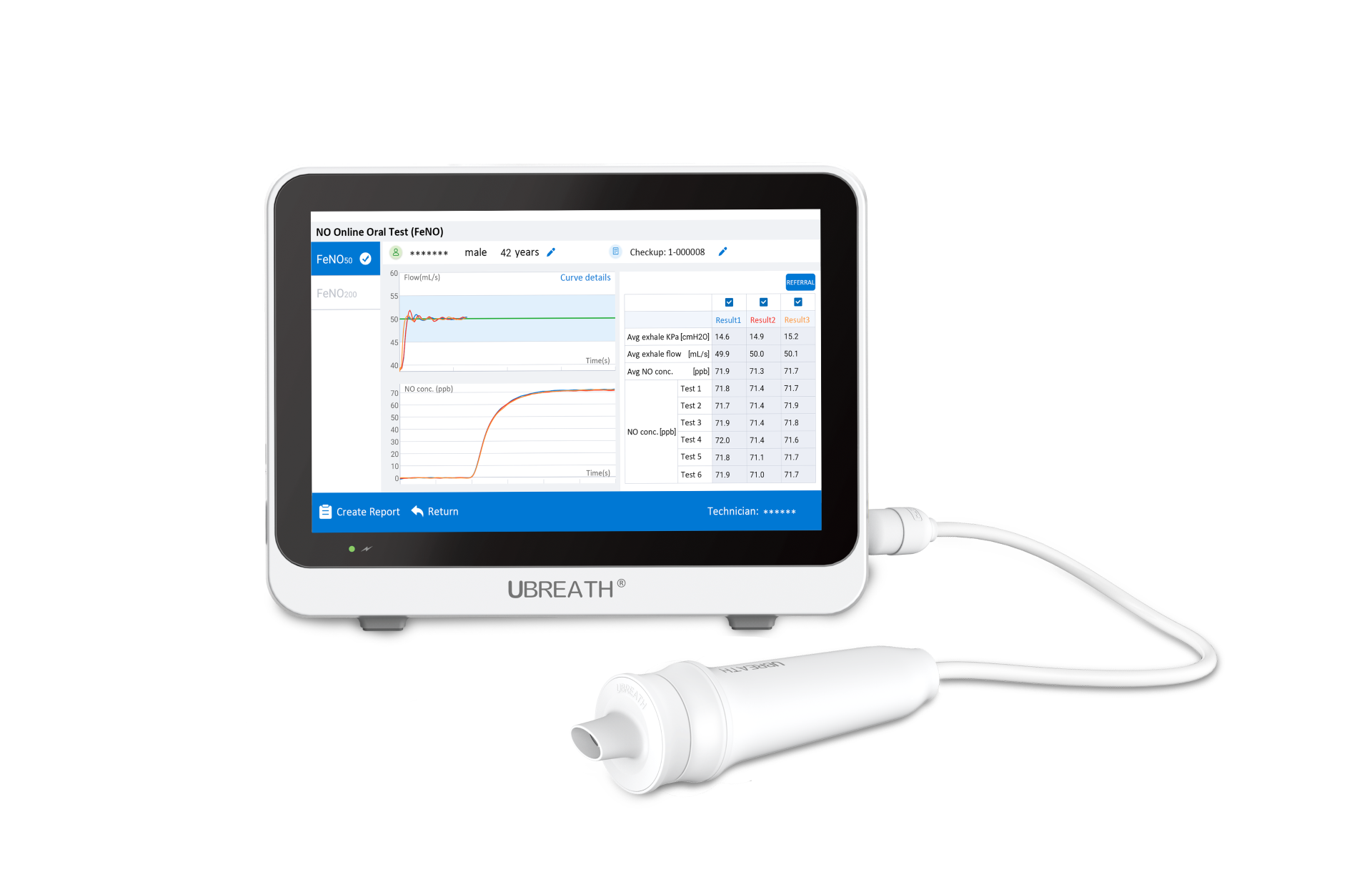
This is exactly where the BA200 excels. The device is equipped with a built‑in flow‑control system that continuously monitors the patient’s exhalation pressure in real time and automatically adjusts the internal resistance to maintain a stable flow of 50 mL/s – regardless of how the patient’s exhalation effort changes.
In practice, this means:
-
The patient simply exhales naturally through the mouthpiece, without needing coaching on “the right force”.
-
The BA200’s servo‑controlled mechanism compensates for pressure drops or surges, keeping the flow constant within a tight tolerance.
-
The measurement is always conducted at the guideline‑recommended flow, so the FeNO value truly reflects the airway inflammatory status, not the patient’s performance.
This automatic stabilisation transforms FeNO testing from a skill‑dependent procedure into a reliable, operator‑friendly routine.
Clinical benefits of a standardised flow
By ensuring strict compliance with the ATS/ERS 50 mL/s requirement, the BA200 delivers three tangible advantages:
-
Reliability – Intrasubject and intersubject variability is dramatically reduced, making serial measurements truly comparable and trend analysis trustworthy.
-
Ease of use – Healthcare professionals spend less time instructing patients and re‑taking failed attempts, improving clinic workflow and patient comfort.
-
Confidence in decision‑making – Clinicians can base their diagnosis, phenotyping, and therapy adjustments on FeNO data that are collected under internationally recognised standards, avoiding the pitfalls of flow‑induced artefacts.
Conclusion
In the era of precision respiratory medicine, standardisation is not a luxury – it is a necessity. The international guidelines have set 50 mL/s as the gold standard for FeNO measurement, but translating that standard into daily practice has long been a challenge due to patient‑related pressure variability. The BA200’s intelligent flow‑control system bridges this gap, ensuring that every single test meets the same rigorous criteria, regardless of who is blowing or how hard they blow.
With such technology, FeNO becomes not just a biomarker, but a dependable clinical tool – one that empowers clinicians to deliver better, more personalised care for patients with airway diseases.