FeNO Testing: A Window into the "One Airway" — Diagnosing Asthma When Rhinitis or Sinusitis Is Also Present
Introduction
Asthma, allergic rhinitis, and chronic sinusitis are among the most common respiratory conditions worldwide. For decades, physicians have recognized that these conditions frequently occur together — but only more recently has the medical community come to understand why. The nose and the lungs are not separate organs; they are two ends of the same continuous respiratory tract. This understanding has given rise to the "one airway, one disease" concept, which holds that inflammation in the upper airway (the nose and sinuses) and inflammation in the lower airway (the bronchi and lungs) are intimately connected.
The statistics are striking. Among patients with allergic rhinitis, the prevalence of asthma is approximately 33%; among those with chronic sinusitis, it rises to 42%. Conversely, up to 80% of asthma patients show evidence of chronic rhinosinusitis. When a patient presents with rhinitis or sinusitis, the question is not whether asthma might be present, but how to detect it — especially when symptoms are subtle or atypical.
This is where FeNO testing enters the picture.

What Is FeNO?
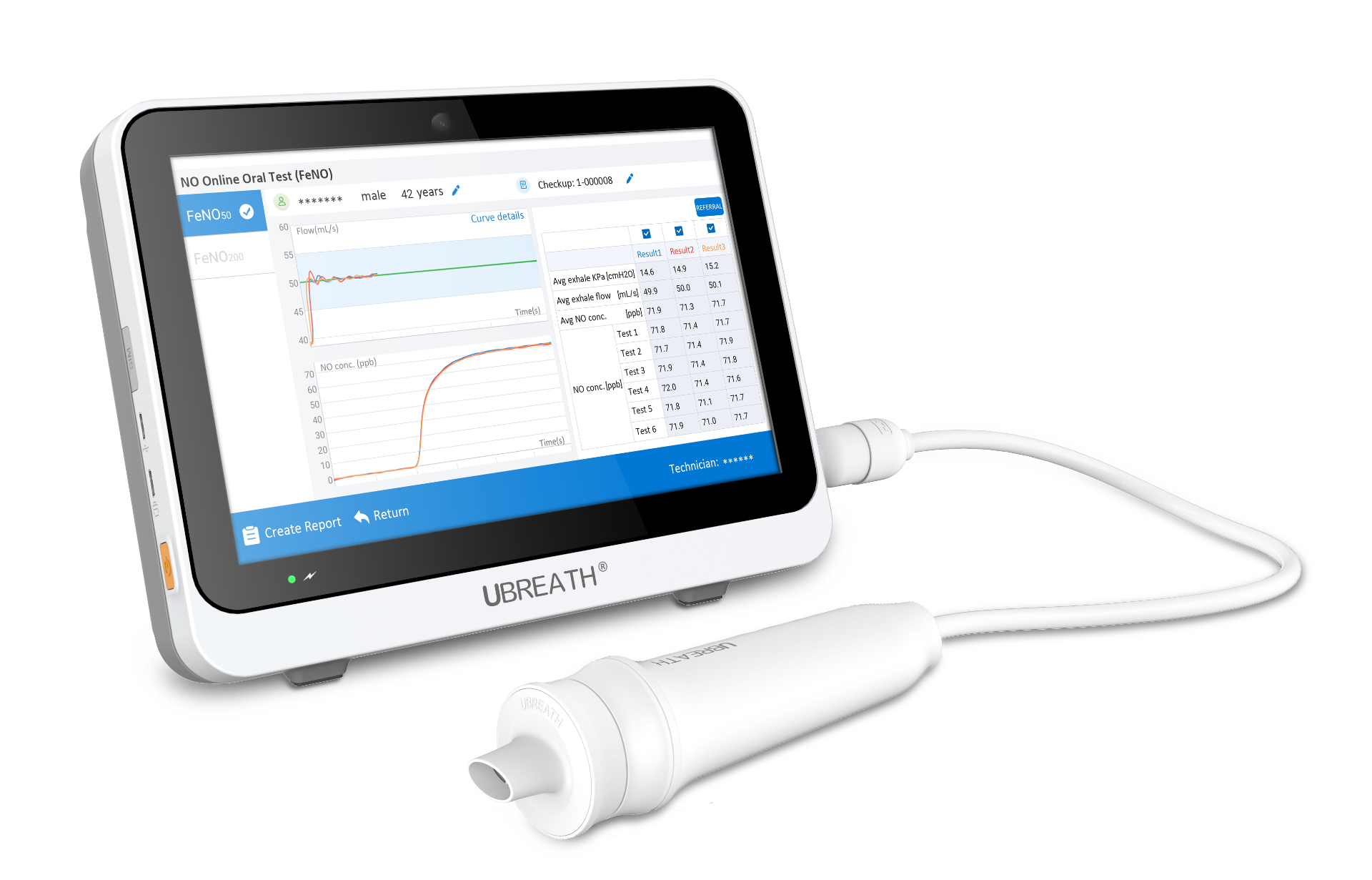
FeNO stands for fractional exhaled nitric oxide — a simple, non-invasive measurement of the concentration of nitric oxide (NO) gas in a person's exhaled breath. The test is remarkably easy to perform: the patient takes a deep breath and then exhales steadily into a handheld device at a controlled flow rate, following guidelines established by the American Thoracic Society and the European Respiratory Society. Results are available within minutes.
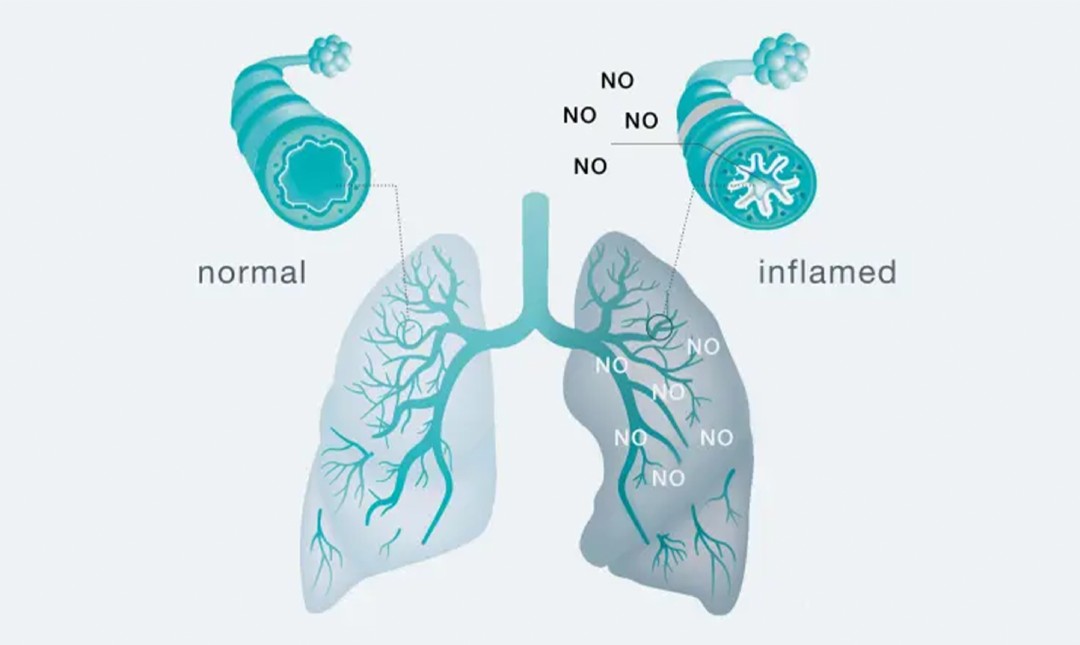
But why measure nitric oxide? Nitric oxide is produced by inflammatory cells — particularly eosinophils — in the airways during type 2 (allergic) inflammation. When airway inflammation increases, FeNO levels rise. When inflammation subsides with treatment, FeNO levels fall. In essence, FeNO serves as a biomarker — a biological yardstick — for eosinophilic airway inflammation.
FeNO in Asthma: The Established Role
In asthma management, FeNO has become an indispensable tool. It helps clinicians confirm the diagnosis of eosinophilic asthma, assess the likelihood of response to inhaled corticosteroids, and monitor treatment effectiveness. Elevated FeNO levels reflect the intensity of eosinophilic inflammation in the bronchial mucosa.
But FeNO is not exclusive to asthma. Patients with allergic rhinitis — even those without any asthma symptoms — may have elevated FeNO levels that reflect ongoing inflammation in the lower airways. This creates both a challenge and an opportunity: the challenge is that FeNO elevation alone does not confirm asthma; the opportunity is that FeNO can serve as an early warning signal for lower airway involvement in patients presenting with upper airway disease.
The Diagnostic Dilemma: Asthma + Rhinitis or Sinusitis
When a patient has rhinitis or sinusitis, diagnosing concomitant asthma can be difficult. Classic asthma symptoms — wheezing, chest tightness, shortness of breath — may be absent or attributed to the upper airway condition. Spirometry (lung function testing) may be normal, especially in mild or early asthma. Yet the underlying type 2 inflammation may already be affecting both the upper and lower airways.
This is where FeNO testing provides unique value.
FeNO and Allergic Rhinitis
Patients with allergic rhinitis show significantly higher FeNO levels than healthy individuals. More importantly, FeNO levels tend to be even higher in patients who have both allergic rhinitis and asthma compared to those with rhinitis alone. One study found that FeNO values in allergic rhinitis patients with asthma were approximately 61.5 ppb (parts per billion), compared to 29.5 ppb in those with rhinitis alone.
The diagnostic value of FeNO is particularly strong in patients with both atopy (allergic sensitization) and rhinitis. In one analysis, FeNO testing achieved an area under the curve (AUC) of 0.752 for identifying asthma in this group — significantly higher than in patients without atopy and rhinitis (AUC 0.693). At a cutoff of 23.5 ppb, FeNO had 100% negative predictive value for ruling out asthma in patients with atopy and rhinitis — meaning that a FeNO level below this threshold virtually excludes asthma in this population.
This makes FeNO an excellent screening tool for detecting lower airway involvement in patients with allergic rhinitis — helping to identify those who need further asthma evaluation before their condition progresses.
FeNO and Chronic Rhinosinusitis
The relationship between FeNO and chronic rhinosinusitis (CRS) is equally illuminating. Patients with CRS and asthma have significantly higher FeNO levels than those with CRS alone. In one study, FeNO levels were significantly higher in asthmatics with CRS (median 54.0 ppb) than in asthmatics with rhinitis (34.6 ppb) or asthmatics without upper airway disease (33.9 ppb).
For patients with chronic rhinosinusitis with nasal polyps (CRSwNP) — a particularly severe subtype — FeNO testing has shown remarkable diagnostic potential. One landmark study found that a FeNO level of 27 ppb could effectively discriminate patients with asthmatic type 2 CRSwNP, with an AUC of 0.848, sensitivity of 90.9%, and specificity of 63.9%. When FeNO was combined with blood eosinophil percentage, the diagnostic accuracy improved even further: at cutoffs of 68 ppb and 5.6%, respectively, the combination achieved 95.5% sensitivity and 86.1% specificity (AUC 0.931).
Perhaps most importantly, FeNO can help identify asthmatic type 2 CRSwNP even before biopsy or formal asthma evaluation. This early identification allows clinicians to select appropriate treatments earlier — potentially preventing disease progression and improving outcomes.
Distinguishing Upper from Lower Airway Inflammation
One of the most powerful applications of nitric oxide measurement is the ability to distinguish between upper and lower airway inflammation. While FeNO (measured from the lower airways) reflects bronchial inflammation, nasal nitric oxide (nNO) (measured from the nose) reflects sinonasal inflammation.
The patterns are distinctive:
-
Higher nNO levels reflect the presence of allergic rhinitis
-
Higher FeNO levels reflect the presence of asthma — especially asthma with CRS
-
In patients with CRS, nNO levels are typically decreased, while FeNO may be elevated — particularly when asthma is also present
By measuring both FeNO and nNO together, clinicians can obtain a complete picture of airway inflammation across the entire respiratory tract. This combined approach is especially valuable in patients with suspected "united airway disease" — the clinical manifestation of the one airway concept.
Practical Clinical Application
So how does FeNO testing translate into clinical practice for patients with rhinitis or sinusitis?
For the patient with allergic rhinitis: If FeNO is elevated (generally >25-30 ppb), it suggests that eosinophilic inflammation extends beyond the nose into the lower airways. This patient should undergo formal asthma evaluation — including spirometry and, if needed, bronchial challenge testing — even if they report no chest symptoms. Early detection allows early intervention, potentially preventing the progression from rhinitis to clinical asthma — a phenomenon known as the "allergic march."
For the patient with chronic sinusitis: If FeNO is elevated, the clinician should suspect concomitant asthma, particularly the type 2 eosinophilic subtype. In patients with nasal polyps, FeNO testing can help identify those with underlying asthmatic type 2 inflammation who may benefit from biologic therapies targeting type 2 pathways.
For the patient with established asthma: FeNO monitoring can help assess whether upper airway inflammation (rhinitis or sinusitis) is contributing to poor asthma control. Elevated FeNO despite appropriate asthma therapy may indicate that the upper airway disease needs more aggressive management.
Important Caveats
While FeNO is a powerful tool, it is not a standalone diagnostic test. FeNO can be elevated in conditions other than asthma, including allergic rhinitis alone. Conversely, a normal FeNO does not exclude non-eosinophilic asthma. FeNO levels can also be affected by smoking, bronchoconstriction, obesity, and other factors.
Therefore, FeNO should be used as one component of a comprehensive diagnostic evaluation — alongside clinical history, physical examination, spirometry, and when indicated, allergy testing and imaging studies.
Conclusion
The "one airway, one disease" concept has transformed our understanding of respiratory medicine. FeNO testing has emerged as a practical, non-invasive, and clinically valuable tool for bringing this concept to the bedside — particularly in the challenging scenario of diagnosing asthma in patients who also have rhinitis or sinusitis.
For the patient with allergic rhinitis, an elevated FeNO level may be the first clue that inflammation has spread beyond the nose. For the patient with chronic sinusitis, FeNO can help uncover hidden asthma that might otherwise go undetected. And for the clinician, FeNO provides objective, real-time evidence of type 2 airway inflammation — guiding diagnosis, treatment decisions, and monitoring of response to therapy.
In an era of precision medicine, FeNO testing represents a step forward — moving us from symptom-based guessing to biomarker-guided clarity. For the millions of patients worldwide living with the overlap of asthma, rhinitis, and sinusitis, that clarity can make all the difference.