The Importance of Repeatability in FeNO Testing: Why Consistency Matters
Fractional exhaled nitric oxide (FeNO) has become an indispensable tool in respiratory medicine. As a non-invasive biomarker of Type-2 airway inflammation, FeNO testing is now widely used in asthma diagnosis, monitoring, and treatment guidance. But how much can clinicians and patients trust a single FeNO reading? The answer lies in one critical concept: repeatability
 .
.
What Is Repeatability?
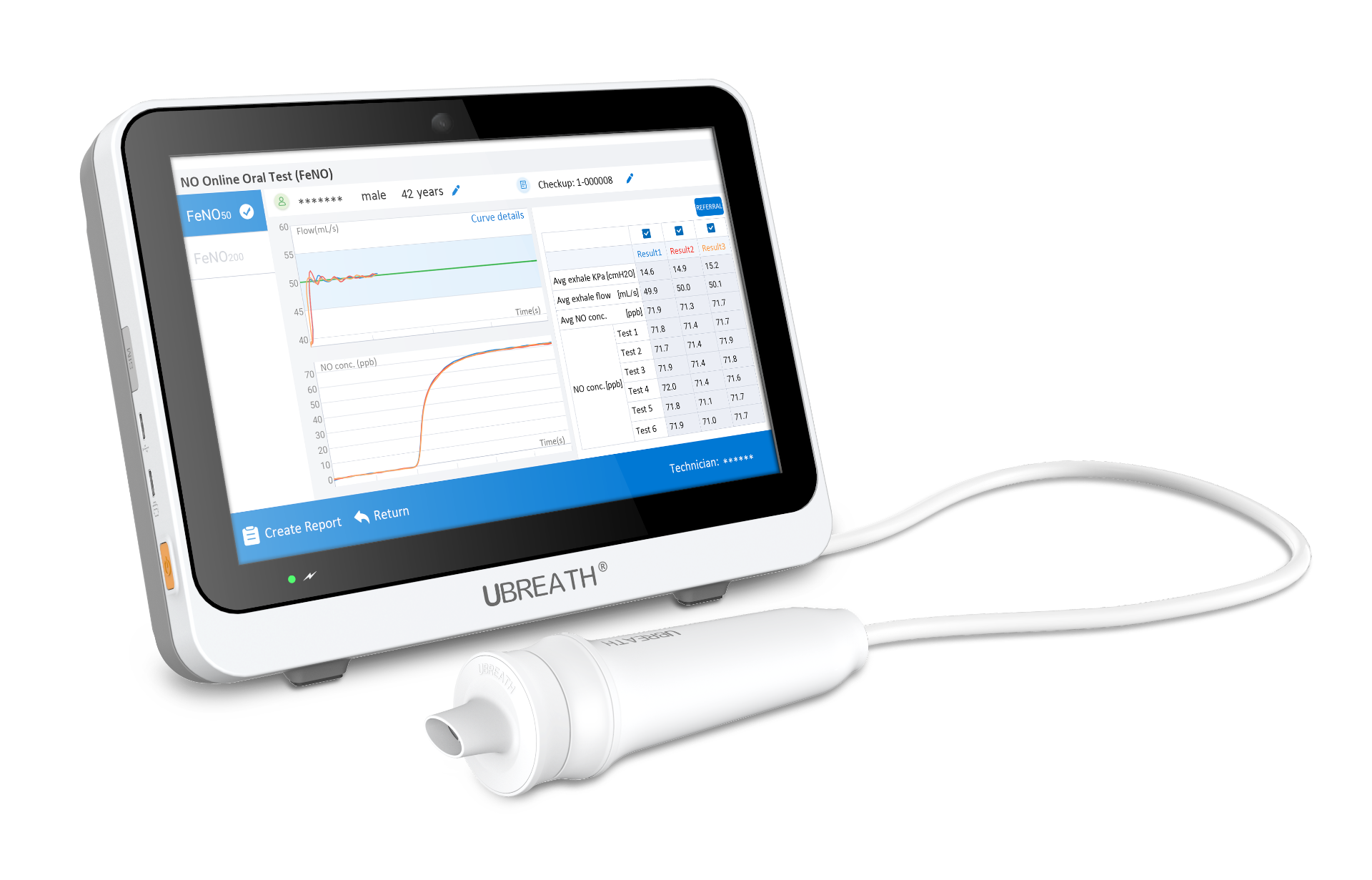
In the context of FeNO testing, repeatability refers to the consistency of measurement results when the test is performed multiple times under the same conditions—typically within the same session or on consecutive days. A highly repeatable test produces very similar values each time it is performed, giving clinicians confidence that a single reading accurately reflects the patient's true airway inflammatory status.
The American Thoracic Society (ATS) and European Respiratory Society (ERS) have long recognized the importance of repeatability. Their joint 2005 recommendations for standardized FeNO measurement procedures emphasize that tests must yield "accurate, repeatable, and clinically meaningful readings". The guidelines specifically recommend performing multiple measurements per patient and obtaining at least two results with an error within 10%.
The Evidence: FeNO Is Highly Repeatable
Decades of research have consistently demonstrated that FeNO measurements are remarkably repeatable—provided the test is performed correctly.
Exceptional intra-class correlation. A landmark study examining FeNO reproducibility across 59 subjects (both healthy and asthmatic adults and children) found an intraclass correlation coefficient (ICC) of 0.99—nearly perfect agreement. The coefficient of reproducibility, expressed as the mean pooled standard deviation across 675 estimations, was just 2.11 parts per billion (ppb). In simpler terms, when you measure FeNO repeatedly, you get almost the same number every time.
Excellent device performance. Modern FeNO devices perform equally well. A prospective trial comparing three different instruments—including handheld devices and a gold-standard reference—found that all three showed high repeatability with ICC > 0.98 across a wide range of FeNO values (2.5 to 191.9 ppb). Another validation study of the NIOX MINO handheld monitor reported a mean coefficient of variation of just 2.4% for FeNO measurements above 30 ppb.
Stability over time. FeNO levels remain stable not only within a single session but also across days. A 2025 study examining FeNO stability over three consecutive days found that less than 0.5% of variability was attributable to the day of measurement—meaning more than 99.5% of results were essentially identical. The same study concluded that FeNO levels are "very stable," supporting the view that repetition is not necessary, at least within the same week.

Why Repeatability Matters in Clinical Practice
1. Confidence in Single Measurements
Because FeNO has such excellent repeatability, a single technically acceptable measurement—performed using the proper method—is generally sufficient for clinical decision-making. This has important practical implications: it reduces patient burden, saves time, and lowers healthcare costs.
A 2017 study involving 132 adult outpatients confirmed that repeated FeNO measurements during the same session showed high reproducibility (ICC > 0.9) and strong correlation (Pearson coefficient > 0.9). The predictive power of the first measurement (sensitivity 80.5%, specificity 85.1%) was not inferior to the second measurement or the geometric mean of both. The authors concluded that repeated measurement is not essential when the first acceptable measurement is performed correctly.
2. Reliable Monitoring Over Time
For patients with asthma, FeNO is often measured repeatedly over weeks or months to track disease control and treatment response. The high repeatability of the test means that changes in FeNO levels over time can be confidently attributed to genuine changes in airway inflammation—not to measurement error.
However, it is important to distinguish between short-term repeatability (consecutive blows within a session) and within-day variability in certain patient populations. While mild-to-moderate asthma shows excellent repeatability from consecutive blows, patients with severe asthma may demonstrate more significant within-day variation. One study reported a median difference of 12 ppb between peak and trough readings within a 24-hour cycle in stable mild-to-moderate asthma. Clinicians should be aware that in severe asthma, the timing of measurement may influence clinical decisions.
3. Distinguishing True Change from Noise
When monitoring any biomarker, it is essential to know the minimal important difference—the threshold above which a change between two measurements is considered clinically meaningful rather than random variation.
For FeNO, the coefficient of variation (CV) in healthy subjects is relatively low, around 10%. When the difference between two measurements exceeds the CV, it is generally considered that a true biological change has occurred. This understanding allows clinicians to interpret serial FeNO measurements with confidence, adjusting treatment when levels rise (indicating worsening inflammation) or fall (indicating improvement).
What Affects Repeatability?
While FeNO is inherently repeatable, several factors can influence measurements and should be controlled to ensure consistency:
-
Exhalation flow rate — The ATS/ERS guidelines specify a standardized exhalation flow rate (50 mL/s for adults) to ensure consistent and comparable measurements
-
Patient preparation — Caffeine, alcohol, nitrate-rich meals, and exercise can all affect FeNO levels and should be avoided before testing
-
Technical validity — Measurements must be technically acceptable, with proper exhalation technique and device calibration
-
Disease severity — As noted, severe asthma may show greater within-day variability
Conclusion
The repeatability of FeNO testing is one of its greatest strengths. With intraclass correlation coefficients approaching 0.99, coefficients of variation under 10%, and remarkable stability across days, FeNO stands as one of the most reliable biomarkers available in respiratory medicine.
For patients, this means that a FeNO test is not only quick and non-invasive but also trustworthy. For clinicians, it means that a single, properly performed measurement provides a solid foundation for diagnosis and treatment decisions. And for both, the high repeatability of FeNO ensures that when levels change, you can be confident that the change is real—not a fluke of measurement.