The Quiet Signal in Your Nose: What FnNO Testing Reveals About Upper Airway Inflammation
Your nose is not just a passage for air. Its lining and the sinuses surrounding it are biochemical factories, quietly releasing a gas called nitric oxide (NO) with every breath. Measuring this gas through a test called fractional nasal nitric oxide (FnNO) has become one of the most elegant tools in modern respiratory medicine—a non-invasive “window” into what is happening inside the upper airway.

What Exactly Is FnNO?
Nitric oxide is a tiny gas molecule produced continuously by cells lining the nose and paranasal sinuses, primarily through enzymes called nitric oxide synthases. The sinuses are especially prolific producers: the amount of NO generated there far exceeds what is produced in the nasal cavity or nasopharynx.
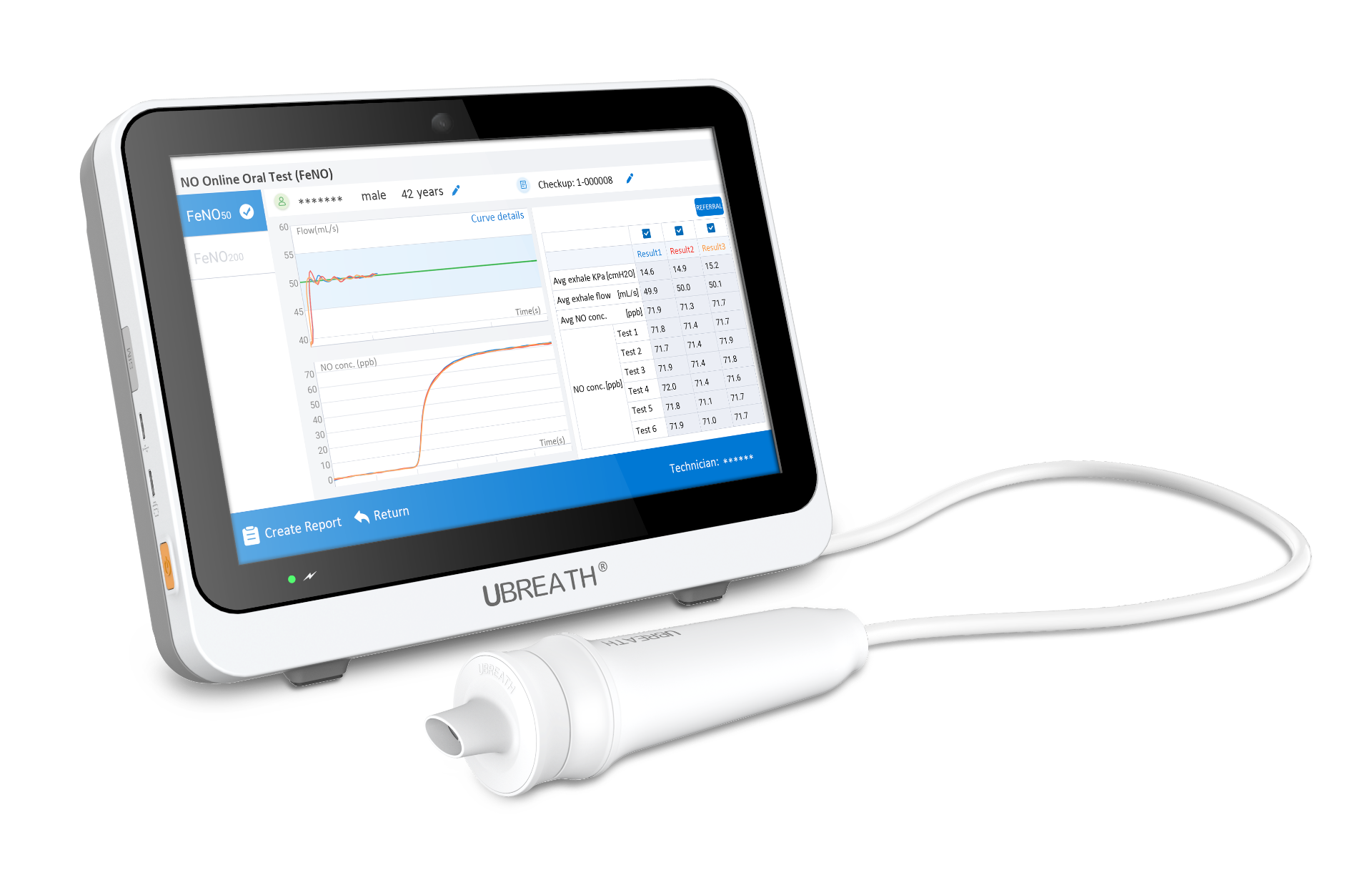
FnNO testing captures this nasal and sinus-derived NO as a person breathes through the nose, measured at a standardized aspiration flow rate (commonly 10 mL/s in clinical practice). It is distinct from the more familiar FeNO test, which samples exhaled breath through the mouth and reflects inflammation in the lower airways, such as in asthma. FnNO, by contrast, speaks specifically to the upper airway—the nose and sinuses.
Why Does the Body Make Nitric Oxide in the Nose?
Nasal NO is not a byproduct. It serves real physiological functions: it helps stimulate ciliary motility (the tiny hair-like structures that sweep mucus), contributes to local host defense with antibacterial and antiviral effects, and helps regulate airway and vascular tone. In health, these processes keep nasal NO within a relatively stable range. When inflammation strikes, however, that range shifts—and the direction of the shift depends on the type of inflammation.
The Clinical Value: A Tale of Highs and Lows
The most clinically useful insight from FnNO is that different upper airway diseases push the reading in different directions.
In allergic rhinitis, FnNO typically rises. The eosinophilic inflammation that drives allergic reactions upregulates NO production, and studies have shown that higher FnNO levels correlate with more severe symptoms. This makes FnNO a candidate biomarker not only for identifying allergic inflammation but also for tracking how well it is controlled: as treatment takes effect, the reading tends to fall.
In chronic rhinosinusitis, the picture flips. FnNO often drops below normal. The mechanism is partly mechanical: swollen sinus mucosa blocks the sinus openings (ostiomeatal complex), trapping the NO-rich air inside the sinuses so it cannot escape into the nasal cavity for measurement. Tissue damage and reduced NO synthesis may also contribute. FnNO can therefore serve as an indirect marker of sinus ostial patency—how well the sinuses are draining.
The most dramatic FnNO reduction occurs in a rare inherited condition called primary ciliary dyskinesia (PCD). In PCD, defective cilia impair mucus clearance, leading to chronic sinus and lung disease. Nasal NO is consistently and markedly low in most PCD patients, making FnNO a first-line screening tool that is sensitive, specific, and far less invasive than genetic or electron-microscopy testing.
What the Numbers Mean
For healthy individuals, nasal NO levels are generally in the range of 250–500 ppb, according to the 2025 Chinese expert consensus on exhaled NO testing. These values are far higher than typical FeNO readings (often under 25 ppb in healthy adults), reflecting the sinuses’ role as the body’s NO reservoir.
For PCD screening, two cutoffs are widely cited. In children and adolescents aged 5–17, an FnNO below 127 ppb (after excluding cystic fibrosis) carries a sensitivity and specificity of approximately 98% and 99% for PCD diagnosis. In individuals with clinical features suggestive of PCD, a value below 77 ppb supports the diagnosis with reliability comparable to electron microscopy or genetic testing.
How the Test Is Done
FnNO testing is remarkably simple. The patient sits comfortably, ensures a tight seal around a nasal sampling device, and breathes in a controlled manner while the analyzer measures NO concentration. The entire process usually takes only minutes and requires no fasting or sedation.
Standardization matters, however. The European Respiratory Society has published technical standards emphasizing that results depend on device type (chemiluminescence versus electrochemical analyzers), ambient NO levels, and the breathing maneuver used. Factors such as recent exercise (which can lower nasal NO), nitrate-rich foods, acute viral infections, and nosebleeds can all influence readings and must be considered when interpreting results.
What FnNO Is—and Is Not
FnNO is not a stand-alone diagnostic test. It is best understood as a physiological signal that complements clinical judgment, symptoms, imaging, and other tests. Its strengths lie in its non-invasiveness, repeatability, and ability to capture inflammatory activity in real time. Its limitations include variability across devices and patient populations, and the fact that chronic rhinosinusitis can produce mixed patterns depending on whether eosinophilic inflammation coexists with sinus obstruction.
What FnNO offers is something rare in medicine: a direct, painless glimpse into an otherwise hidden compartment. For a child with recurrent nasal symptoms, a low FnNO can flag the need for PCD workup before irreversible lung damage occurs. For a patient with allergic rhinitis, a falling FnNO may confirm that treatment is working. For the clinician, it is a quiet but informative signal—one breath at a time.