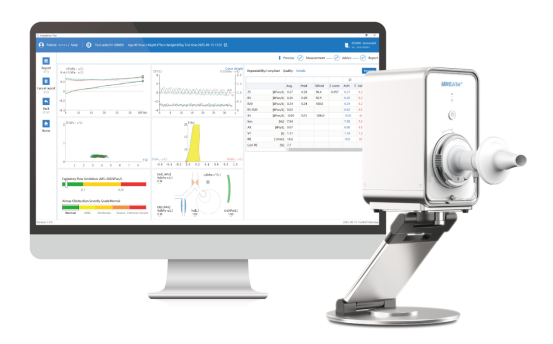
Impulse Oscillometry vs. Forced Oscillation Technique: Why IOS Takes the Lead
Introduction
For decades, lung function testing has relied heavily on spirometry—a test that requires patients to perform forceful, maximal expiratory maneuvers. While effective, spirometry presents significant challenges: young children cannot cooperate, elderly or frail patients struggle with the effort, and many individuals with respiratory disease simply cannot produce acceptable quality results.
Enter oscillometry—a family of techniques that measure lung mechanics during quiet tidal breathing, requiring no forced maneuvers whatsoever. Among oscillometry methods, two names frequently arise: the Forced Oscillation Technique (FOT) and Impulse Oscillometry (IOS) . While IOS is technically a variant of FOT, the differences between them are substantial—and IOS offers distinct advantages that make it the preferred choice in many clinical settings.
The Common Foundation: What Both Techniques Share
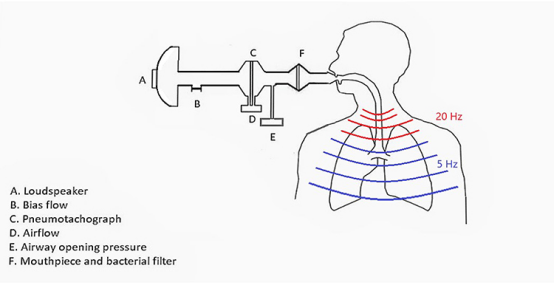
Both FOT and IOS are non-volitional methods for assessing respiratory impedance—the relationship between pressure and flow in the respiratory system. They superimpose small external pressure oscillations on the patient's spontaneous breathing and measure the resulting pressure and flow signals to calculate two key parameters:
-
Resistance (Rrs) : the real part of impedance, reflecting the airway caliber and the resistive properties of the respiratory system
-
Reactance (Xrs) : the imaginary part, reflecting the elastic and inertial properties of the lungs and chest wall
Both techniques share the major benefit of requiring only tidal breathing, making them feasible even in preschool children and patients who cannot perform forced exhalation.
The Key Difference: How the Signal Is Delivered
This is where the two techniques diverge—and where IOS begins to shine.
Classical FOT (introduced by Dubois in 1956) generates oscillations using a loudspeaker that produces pseudorandom noise—a mixture of several sinusoidal waveforms. In many implementations, sound waves of different frequencies are transmitted sequentially, one after another.
IOS (developed by Michaelson in 1975), by contrast, delivers all frequencies simultaneously within a single impulse—a rectangular waveform burst. The impulse contains a broad spectrum of frequencies (typically 5 to 35 Hz) that are mathematically decomposed after measurement.
Why This Difference Matters: The Advantages of IOS
1. Faster Testing Time
Because IOS delivers all frequencies in a single burst rather than sequentially, the test can be completed in a matter of seconds—often during just a few breaths. This is particularly valuable in pediatric patients, who have limited attention spans, and in severely dyspneic patients who cannot tolerate prolonged testing.
2. Superior Small Airway Assessment
The ability to measure impedance across a wide frequency range simultaneously gives IOS exceptional sensitivity to small airway dysfunction (SAD) —often the earliest site of pathology in asthma and COPD. Studies have shown that IOS demonstrates similar or even higher sensitivity than spirometry in detecting SAD, and can identify abnormalities even when spirometry remains normal. This makes IOS invaluable for early detection and for monitoring patients with preserved spirometry but symptomatic disease.
3. Effort-Independent and Patient-Friendly
Like FOT, IOS requires only passive cooperation—no forced maneuvers, no maximal inhalation, no breath-holding. However, the speed and simplicity of the IOS impulse make it even more tolerable for challenging populations: young children, elderly patients, individuals with cognitive impairment, and those with severe respiratory distress.
4. Comprehensive Data in One Measurement
The impulse contains a broad spectrum of frequencies, allowing IOS to provide a complete frequency-resolved impedance profile from a single measurement. This includes:
-
R5 (resistance at 5 Hz): reflecting total airway resistance, with a strong contribution from peripheral airways
-
R20 (resistance at 20 Hz): reflecting predominantly central airway resistance
-
X5 (reactance at 5 Hz): reflecting the elastic properties of the peripheral lung
-
Fres (resonant frequency): the frequency at which reactance crosses zero
-
AX (area of reactance): an integrated measure of peripheral airway dysfunction
The difference between R5 and R20 (R5–R20) is particularly valuable—it provides a direct, frequency-based index of peripheral airway involvement.
5. User-Friendly Commercial Implementation
The Jaeger MasterScreen IOS system, introduced as a commercial version of FOT, offers integrated data analysis and elaborate reporting. It includes automated estimations of central and peripheral pulmonary mechanics based on simple mathematical models, making interpretation more accessible for clinicians.
What the Evidence Shows
Multiple studies have compared IOS with classical FOT. A landmark study by Hellinckx et al. (2001) evaluated both techniques in 49 subjects with various lung disorders and found that:
-
IOS and FOT yield similar resistance and reactance values, though not identical
-
IOS resistance values were slightly higher than FOT at lower frequencies (mean difference of 0.14 kPa·L⁻¹·s at 5–6 Hz)
-
Reactance values were very similar between the two techniques
-
Resonant frequency was slightly higher with IOS (mean difference of 1.35 Hz)
These findings confirm that IOS provides clinically comparable information to classical FOT—but with the added benefits of speed, simplicity, and superior data presentation.
Clinical Applications Where IOS Excels
IOS has proven particularly valuable in:
-
Pediatric asthma: where spirometry is often impossible in young children
-
Early COPD detection: identifying small airway changes before spirometric decline
-
Therapy monitoring: tracking response to bronchodilators and anti-inflammatory treatments
-
Occupational lung health: screening asymptomatic workers with preserved spirometry
-
Patients with severe disease: who cannot perform forced maneuvers
Conclusion: IOS as the Evolution of FOT
Impulse oscillometry is not merely an alternative to forced oscillation technique—it is an evolution. Built upon the same foundational principles as FOT, IOS refines the signal delivery from sequential frequencies to a single, broad-spectrum impulse. This refinement translates into faster testing, richer data, greater patient comfort, and superior sensitivity to the earliest signs of airway disease—particularly in the small airways where pathology often begins.
For clinicians seeking a practical, patient-friendly, and physiologically informative tool for lung function assessment, IOS offers the best of both worlds: the non-invasive, effort-independent nature of oscillometry, combined with the speed, simplicity, and clinical insight that modern respiratory medicine demands.