A Quiet Revolution in Lung Testing: How Impulse Oscillometry Is Changing the Way We Measure Breathing
Try to picture a lung function test. For most people, the image that comes to mind is spirometry: a clip on the nose, a tight seal around a mouthpiece, and a technician urging, “Big breath in—now blast it out as hard and fast as you can.” It is effortful, occasionally uncomfortable, and for some people—a preschooler, a frail elderly patient, someone short of breath—it is simply not achievable.
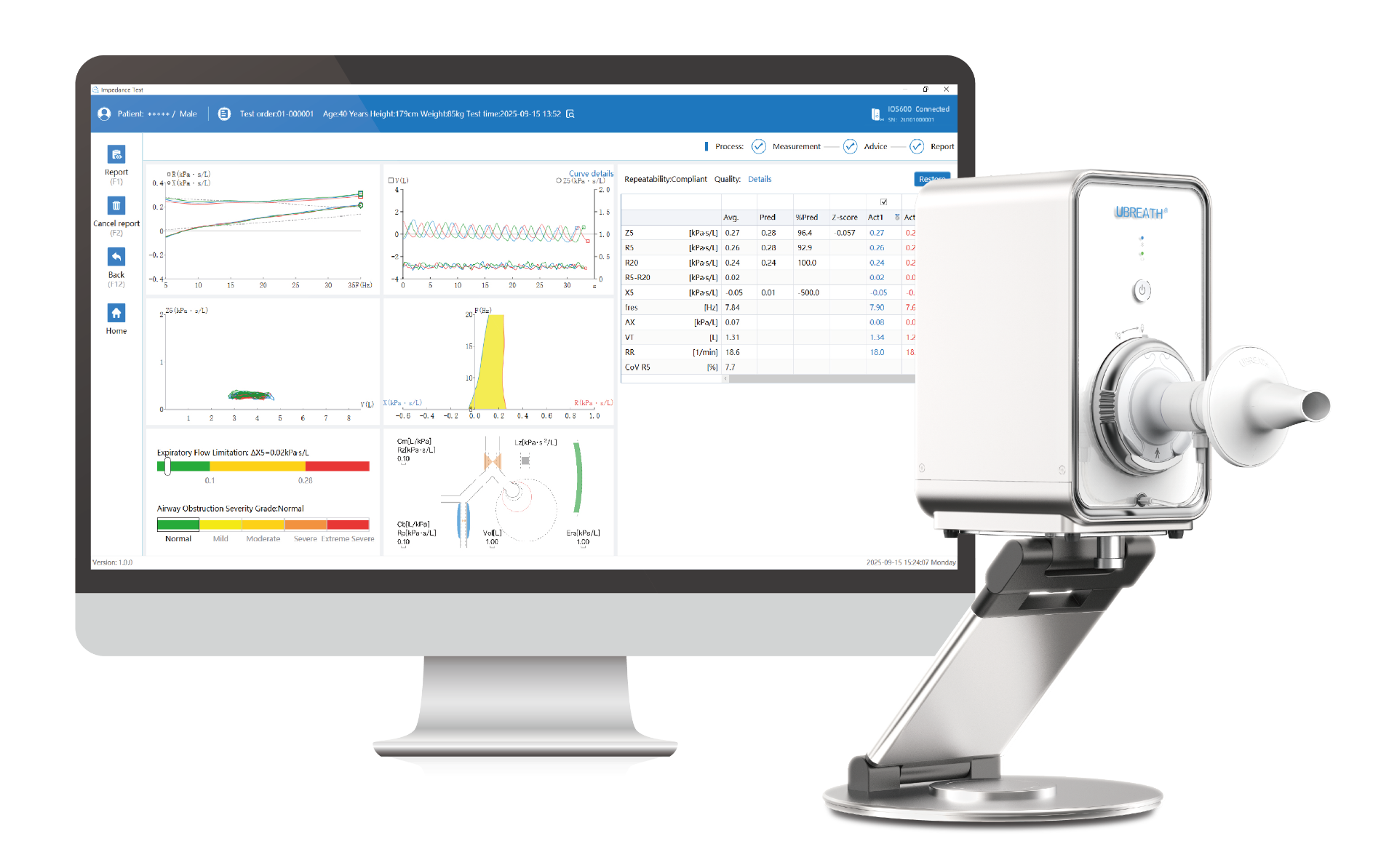
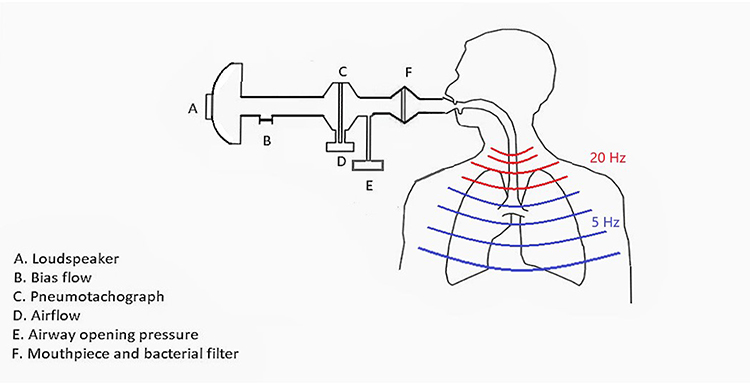
Impulse oscillometry, or IOS, offers a different way. Instead of demanding a forceful maneuver, it asks the patient to do something far simpler: breathe normally into a mouthpiece for a short period while a machine sends tiny, almost imperceptible sound-wave pulses into the airways. From the way those pulses ripple through the respiratory system, IOS builds a detailed picture of how the lungs are behaving mechanically. It is, in a sense, a stethoscope for the physics of breathing—one that listens not to sound, but to resistance and recoil.
What IOS actually measures
The core concept behind IOS is impedance, the total opposition that the respiratory system presents to the oscillating pressure pulses. Impedance has two components: resistance and reactance.
Resistance reflects how hard it is for air to move through the airways—the “friction” of breathing. IOS reports resistance at different frequencies, and the frequency matters a great deal. Resistance at 20 Hz (R20) is thought to reflect the large, central airways, because high-frequency oscillations do not penetrate deeply into the lung periphery. Resistance at 5 Hz (R5), by contrast, represents the total resistance of the entire airway tree. The difference between them, R5–R20, is therefore a window into the small airways—the quiet, narrow distal branches that contribute little to conventional spirometry until disease is advanced.
Reactance, the other half of the equation, describes the elastic and inertial properties of the lung. Reactance at 5 Hz (X5) is often interpreted as a marker of elastic recoil in the peripheral airways. Two related parameters—the resonant frequency (Fres), the frequency at which reactance crosses zero, and the area of reactance (AX), an integrated measure of the reactance burden at low frequencies—are increasingly recognized as sensitive indicators of peripheral airway abnormality.
What makes these numbers clinically interesting is that they can be abnormal when spirometry looks entirely normal. The small airways have long been called the “silent zone” of the lung, and IOS is one of the few noninvasive tools that can make that silence audible.
The quiet advantages
The most obvious advantage of IOS is its effort independence. Because the test is performed during quiet tidal breathing, it does not require a forced expiratory maneuver, breath-holding, or the kind of coordination that spirometry demands. This makes it feasible in populations for whom spirometry is notoriously difficult: young children, elderly patients, individuals with neuromuscular weakness, and those who are acutely breathless. Pediatric guidelines now explicitly position IOS as particularly suited to children who cannot reliably perform conventional forced ventilation testing.
There is a physiological advantage as well. A forced expiratory maneuver is not a neutral act—it can alter airway smooth muscle tone and bronchomotor state. IOS, by contrast, measures the respiratory system during normal breathing, without provoking the airways it is trying to assess.
And then there is the question of sensitivity. Studies comparing IOS with spirometry have found that IOS resistance parameters are more closely associated with obstructive ventilatory impairment, while reactance parameters track restrictive abnormalities, lung volumes, and diffusion impairment. Across diseases, R5–R20 and Fres consistently show higher sensitivity for detecting small airway dysfunction than conventional indices. In asthma, IOS parameters appear able to pick up early changes in lung function and may even outperform spirometry in predicting loss of control.
Where IOS earns its place
IOS is not a replacement for spirometry, and the literature is careful to describe it as complementary. But in several clinical niches, it adds information that spirometry cannot easily provide.
In asthma, IOS is valuable for assessing bronchodilator responsiveness, evaluating control, and detecting small airway involvement when spirometry is preserved. In COPD, IOS can identify small airway dysfunction even in patients whose conventional spirometry results fall within the normal range, and it is sensitive to peripheral changes that traditional tests may miss. In interstitial lung disease, reactance-related parameters show stronger associations with restrictive physiology and diffusion impairment, giving IOS a distinct role beyond airflow obstruction. There is also growing interest in using IOS for monitoring exposure-related airway effects and, with the help of artificial intelligence models, for disease screening and classification.
The caveats worth knowing
No test is without limitations, and IOS is no exception. One persistent challenge is standardization. Device calibration can vary, and the lack of universally agreed thresholds for abnormality limits broader application. Reactance measurements in particular may differ between IOS and other oscillometry devices, underscoring the need for device-specific normative values.
Reference equations are another moving target. Historically, published IOS reference equations covered specific age bands rather than the full lifespan, which could produce discordant predicted values when a patient moved from one equation to another. A 2023 study addressed this by developing segmented regression equations applicable from early childhood to old age—ages 2.7 to 90 years—but such unified references are still not universally embedded in clinical practice.
Interpretation also requires nuance. Spirometry and IOS do not always agree on the presence or severity of small airway dysfunction, and inconsistencies can arise in either direction. The clinical significance of some IOS findings is still being defined, and large-scale, multicenter studies are needed before IOS can be fully integrated into routine guidelines.
The takeaway
Impulse oscillometry represents a genuine shift in how we think about lung function testing: away from “how hard can you blow” and toward “how is your respiratory system behaving while you simply breathe.” Its capacity to detect small airway dysfunction, its feasibility across the age spectrum, and its effort independence make it an attractive complement to spirometry—especially in asthma, COPD, and pediatric populations, where the small airways matter but conventional tests often fall silent.
It is not yet a first-line replacement for spirometry, and it will not be until standardization, reference values, and outcome-based evidence mature. But for the patient who cannot perform a forced breath, or the clinician who suspects early peripheral airway disease despite a normal spirometry result, IOS offers something valuable: a quieter, gentler, and sometimes more revealing way to listen to the lungs.